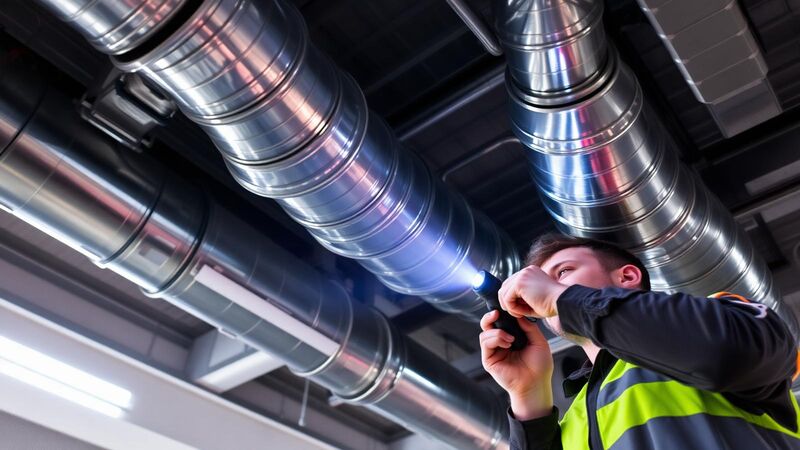
Independent ventilation hygiene assessors · Focused on impartial evidence
Ventilation Hygiene & Ductwork Cleanliness Assessment
Green Air Monitoring provides independent ventilation hygiene assessments for offices and commercial buildings across London and the South East. We assess the condition of your ventilation systems, tell you what action is justified and verify the result. As independent assessors, our findings are focused solely on the hygiene of your system, ensuring our recommendations are entirely objective.
Established 1999 · 2,500+ assessments · SafeContractor approved · BOHS Affiliate Member · London & South East
Our Ventilation Hygiene & Ductwork Cleanliness Assessment Services
TR19 Air Assessments
Full TR19 ventilation hygiene assessments with independent condition reporting.
Learn moreDeposit Thickness Testing (DTT)
On-site deposit thickness readings for suitable ductwork surfaces
Learn moreEVT / PVT Verification
Gravimetric dust testing for pre-clean surveys and post-clean verification
Learn moreKitchen Extract / WFTT
Grease assessment of kitchen extract systems to TR19 Grease
Learn moreDuct Cleanliness Testing
Plain-English condition surveys to find out whether cleaning is actually needed.
Learn morePPM Contracts
Risk-based, portfolio-wide ventilation hygiene programmes with independent verification.
Learn moreAHU Hygiene Inspection
Independent air handling unit condition and hygiene assessment.
Learn moreFresh Air Supply Assessment
CO₂-based assessment of whether spaces receive enough outdoor air.
Learn moreWho Is This For?
Why This Matters
Dirty ductwork and poorly performing HVAC systems can contribute to poor indoor air quality. TR19 provides industry guidance for assessing ventilation-system cleanliness, while poorly maintained systems can harbour biological contaminants, increase energy costs and create fire risks.
- TR19 evidence may be required by an insurer, landlord, contract, fire-risk assessment or client policy
- Contaminated ductwork can spread bacteria and mould spores
- Poorly operating ventilation can allow CO₂ and other pollutants to build up
- Contaminated coils and filters reduce system performance and increase energy use
- The Workplace (Health, Safety and Welfare) Regulations 1992 require adequate ventilation in enclosed workplaces
Our Approach
We inspect accessible parts of the system — intakes, air-handling units, ductwork and terminals — and measure cleanliness with the method that suits each surface and deposit: Deposit Thickness Testing (DTT), the vacuum test (EVT) or, for kitchen extract, Wet Film Thickness Testing (WFTT). Results are classified against BESA TR19® Air (Version 2, 2026) or TR19® Grease, with clear, proportionate recommendations.
Which ventilation hygiene service do I need?
Start from the question you need answered.
| If you need to… | Service |
|---|---|
| Know whether your ductwork needs cleaning | Duct Cleanliness Testing |
| Produce formal TR19 evidence for insurers, landlords or audits | TR19 Air Assessment |
| Get on-site deposit readings on suitable ductwork | Deposit Thickness Testing (DTT) |
| Get a weighed result or verify cleaning | EVT / PVT Verification |
| Assess grease in a commercial kitchen extract | Kitchen Extract / WFTT |
| Check the hygiene condition of air-handling units | AHU Hygiene Inspection |
| Manage ventilation hygiene across several sites | PPM Contracts |
Swipe sideways to see the full table →
Do I need a ventilation hygiene survey? 60-second check
1.Has it been more than 12 months since your ventilation systems were last inspected — or do you not know?
2.Can you see dust or staining around grilles and diffusers?
3.Have staff or tenants complained about stuffiness, odours or dust?
4.Has there been construction, fit-out or refurbishment work in or near the building since the last inspection?
5.Have an insurer, landlord, auditor or client asked for TR19 evidence?
6.Has a contractor recommended cleaning without showing you measured results?
7.Has ductwork recently been cleaned without independent verification?
8.Does the building have a commercial kitchen?
Your result
- Kitchen extract: assess grease with WFTT under TR19 Grease.
- Independent post-clean verification is recommended.
- Get an independent pre-clean survey before approving the quote.
- A formal TR19 Air assessment will give you the evidence requested.
- A condition survey with quantitative testing is recommended; we may add indoor air quality testing if complaints are involved.
- A routine TR19 Air assessment is due.
- Your systems may not need a survey yet. Keep annual inspections in your PPM schedule, and check again if anything changes.
This check is a guide only and does not replace an assessment.
Independent assessor or cleaning contractor?
| Independent assessor (Green Air Monitoring) | Cleaning contractor who also inspects | |
|---|---|---|
| Sells cleaning | No | Yes |
| Decides whether cleaning is needed | Based only on measured results | Often linked to cleaning service provision |
| Cleaning scope | Defined and handed to you to tender | Usually quoted by the same company |
| Post-clean sign-off | Independent re-test at the same locations | Often self-certified |
| Tells you when cleaning is NOT needed | Yes, and records it | Based on contractor service scope |
Swipe sideways to see the full table →
Free guides
Use our practical buyer guides to review a TR19 report, understand your duties or compare ventilation hygiene assessors.
Independent by design
Buildings we assess
We assess ventilation systems in commercial and public buildings across London and the South East.
- Offices and multi-let commercial buildings
- Retail units and shopping centres
- Hotels, restaurants and commercial kitchens
- Schools, colleges and university buildings
- Leisure and public buildings
- Industrial and warehouse premises with occupied offices
Related ventilation hygiene and indoor air quality services
Frequently Asked Questions
Related ventilation hygiene and indoor air quality services
Need Indoor Air Quality Testing?
Get a no-obligation quote. We provide IAQ testing, ventilation assessment and environmental monitoring across London and the South East.