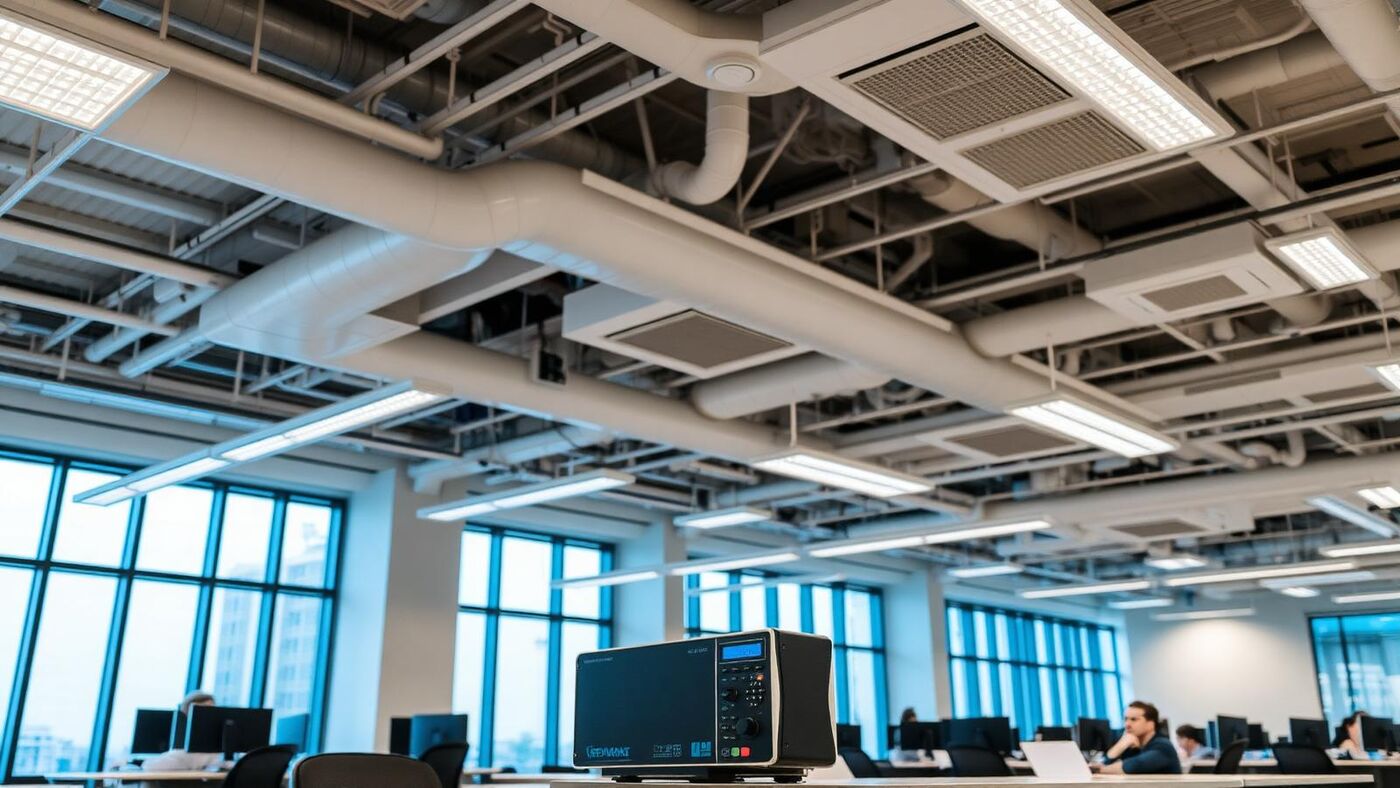
Commercial Property Air Testing
Independent indoor air quality and ventilation assessors · Since 1999
Commercial property air testing gives investors, asset managers and acquisition teams environmental evidence that complements a wider technical review. It can document indoor air quality and accessible ventilation hygiene condition at acquisition, before disposal or while an asset-management plan is being developed. The work is shaped around the transaction question, building access and available programme. Findings are reported with their significance and limitations, allowing decision-makers to separate immediate investigation, planned maintenance and longer-term capital considerations without treating a limited survey as a guarantee of future performance.
Established 1999 · 2,500+ assessments · SafeContractor approved · BOHS Affiliate Member · London & South East
Environmental evidence for a property decision
The instruction starts with the decision and available time. Acquisition work identifies material IAQ or ventilation-hygiene uncertainties; disposal work records condition and open actions. During ownership, evidence separates routine operations, planned maintenance and capital considerations. We coordinate with property advisers while retaining an indoor-environment scope.
Defining a proportionate due-diligence scope
We review plans, occupancy, plant information, maintenance records, complaints and refurbishment history. Locations represent different uses, floors, systems and concerns. Real-time logging may cover CO₂, temperature, humidity, particulates and TVOC. Laboratory analysis is defined for specific substances or criteria. Accessible AHUs or ductwork can receive an appropriate hygiene inspection, with restrictions recorded.
What the review contributes
| Property decision | Evidence gathered | How it informs the next step |
|---|---|---|
| Acquisition | Representative IAQ patterns, records review and accessible system condition | Flags uncertainty, further investigation and potential asset-plan items |
| Disposal | Documented condition at agreed areas and operating state | Supports a clear account of observed findings and open actions |
| Asset planning | Location-specific results linked to systems and occupied uses | Separates operational changes from maintenance and capital priorities |
| ESG review | Repeatable environmental indicators with method and context | Provides traceable evidence for appropriately framed reporting |
| Portfolio review | Consistent scope and reporting categories across selected assets | Enables comparison without ignoring building-specific differences |
Swipe sideways to see the full table →
From findings to capital priorities
We distinguish measured findings from matters needing confirmation. Actions identify operational changes, HVAC investigation, hygiene maintenance, targeted sampling or verification. Priority reflects significance, confidence and practical sequence. Appointed designers or contractors develop repair solutions and budgets; we explain the evidence behind the need.
Portfolio benchmarking without false equivalence
Across several properties, consistent location rules, monitoring context and reporting support exception analysis. Comparisons retain occupancy, building form, ventilation and seasonal context, helping asset teams prioritise investigation or investment without treating unlike properties as equivalent.
ESG evidence that retains its context
Indoor-environment measurements can support ESG records when method, period, locations and interpretation remain attached. Results explain each parameter and subsequent action. Formal WELL verification remains with a WELL Performance Testing Agent; BREEAM evidence is scoped to applicable criteria.
Working within transaction programmes
We agree timing around access, occupancy and the decision programme. If the window restricts meaningful monitoring, we state what can be established and what remains for follow-up. Out-of-hours visits can be arranged where operations require them, with travel from Bexley addressed in the scope.
Is this the right page?
Landlord Air Quality Assessment is for operational issues in owned or managed buildings, including lease boundaries and tenant concerns. Multi-Site IAQ Monitoring is for an ongoing, standardised programme across a portfolio rather than a transaction-specific review.
Limitations and what this assessment cannot tell you
Due-diligence findings are bounded by access, documents, occupancy and the assessment period available.
- Representative checks cannot establish the condition of every room or concealed system section
- A vacant building cannot demonstrate performance under future occupied use
- Environmental assessment does not replace structural, mechanical, legal or valuation advice
- Laboratory identification is included only where it is specified in the agreed scope
- Future performance depends on operation, occupancy, maintenance and subsequent fit-out
What the property evidence pack includes
Reporting is structured for technical review and asset-level decisions.
- Instruction, transaction context and documents reviewed
- Areas, systems, occupancy and access constraints
- Monitoring methods, durations and laboratory work where commissioned
- Findings classified by evidence strength and significance
- Operational, investigation, maintenance and capital-plan actions
- Portfolio summary format where several assets are assessed
Related indoor air quality services
Frequently Asked Questions
Need Indoor Air Quality Testing?
Get a no-obligation quote. We provide IAQ testing, ventilation assessment and environmental monitoring across London and the South East.