Sick Building Syndrome Investigation
Independent indoor air quality investigators
Sick building syndrome is a practical term for clusters of non-specific symptoms that occupants associate with time in a particular building and that tend to ease away from it. The term is not a medical diagnosis and does not identify a single cause. Our role is to examine the indoor environment, occupancy pattern and ventilation evidence so workplace teams can understand whether measurable building conditions align with the reported pattern.
Established 1999 · 2,500+ assessments · SafeContractor approved · BOHS Affiliate Member · London & South East
Turning a broad concern into a testable brief
Reports may include headaches, tiredness, dry eyes, throat irritation, discomfort or difficulty concentrating. These experiences have many possible influences and should not be assigned to the building without evidence. We establish which areas, days and periods are involved; whether several people describe a similar pattern; and whether changes coincide with occupancy, cleaning, refurbishment, temperature or ventilation operation. Personal medical details are neither requested nor interpreted.
Occupant questionnaire and building walk-through
A short, anonymised questionnaire records location and timing rather than names or diagnoses. Questions cover work area, days present, when discomfort begins, whether it changes away from the building, and observations about temperature, odour, dust or stuffiness. Responses are grouped to reveal spatial or time-based patterns. The walk-through then reviews room use, occupancy, air supply and extract points, openable windows, printers, cleaning activities, moisture signs, local heat sources and recent fit-out work.
What we measure and how
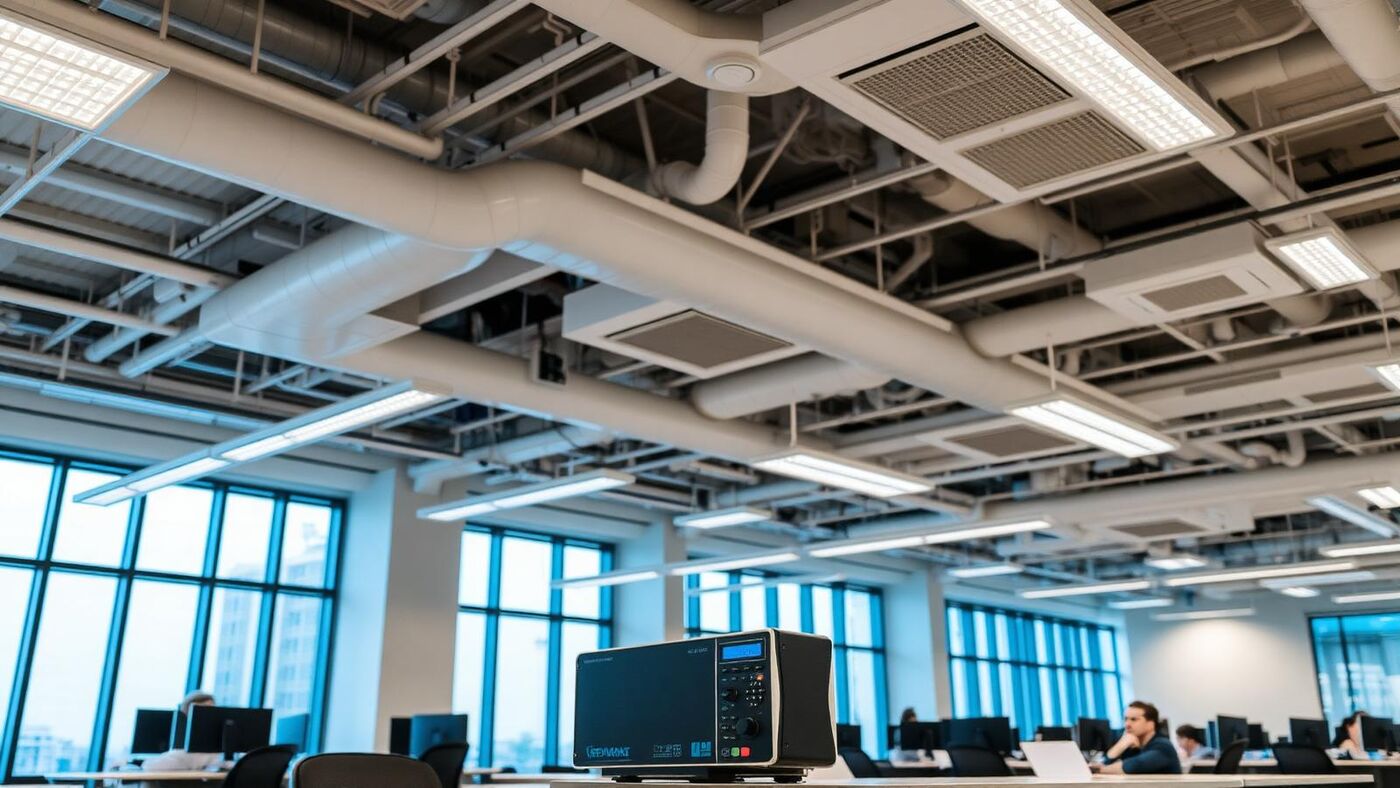
Real-time loggers commonly record carbon dioxide, temperature and relative humidity across occupied periods. Carbon dioxide helps show how ventilation responds to occupancy; it is not a measure of every pollutant. Particulate and TVOC screening can identify changes associated with activities or locations. We inspect accessible air-handling units, filters, coils, trays, grilles and duct condition where ventilation hygiene is relevant. Targeted laboratory sampling is added only when observations suggest a specific substance or microbial question.
Agree the complaint map
Define affected zones, comparison areas, occupancy periods and relevant building events.
Gather anonymous patterns
Use a focused questionnaire to compare time and place without collecting medical histories.
Log occupied conditions
Place instruments where people work and in suitable comparison locations for an agreed period.
Review ventilation hygiene
Inspect accessible components and relate condition to airflow paths and maintenance records.
Integrate the evidence
Compare questionnaire themes, observations, time-series data and any laboratory findings.
Where and for how long
Locations are chosen from the complaint map and building layout, including affected work areas, meeting rooms or cellular spaces, a less-affected comparison zone and an outdoor reference where useful. Logging normally spans representative occupied and unoccupied periods agreed for the case. A brief spot reading cannot show morning start-up, afternoon accumulation or day-to-day changes, so the duration follows the pattern being investigated. Instrument positions, timestamps, occupancy information and plant schedules are retained with the results.
Interpreting findings without overstatement
The investigation can show whether measured conditions, ventilation response or hygiene observations correspond with reported times and places. It can identify practical issues such as poor ventilation response in a crowded room, thermal discomfort, activity-related particles or a local emission pattern. It cannot diagnose illness, establish an individual's medical cause or prove that one environmental factor explains every report. Where evidence is inconclusive, we identify the uncertainty and a proportionate next step rather than forcing a conclusion.
Communicating with staff and involving occupational health
A clear staff summary can explain what was assessed, what the measurements showed and which building actions will follow. It should distinguish measured facts from questions still under review and avoid discussing individual responses. Occupational health should be involved when people need personal clinical advice, symptoms are persistent or serious, fitness for work is being considered, or a medical pattern requires professional assessment. We can coordinate the environmental evidence while occupational health addresses individual wellbeing.
Is this the right page?
Employee Wellbeing Air Testing suits planned evidence gathering for workplace and ESG teams. Office Air Quality Testing suits a technical survey where there is no cluster of building-associated complaints.
Limitations and what this assessment cannot tell you
Environmental assessment supports building decisions but remains separate from clinical evaluation.
- Questionnaires record group patterns and are not diagnostic tools
- Measurements represent the locations, period, occupancy and plant state assessed
- Screening readings may justify specific laboratory analysis but cannot identify all compounds
- Personal health concerns require advice from occupational health or an appropriate medical professional
What your report includes
- Anonymised complaint map and questionnaire themes
- Building-use and ventilation observations
- Logger locations, duration and time-series charts
- CO₂, comfort, particulate and TVOC interpretation
- Ventilation hygiene findings and targeted sample results
- Prioritised building actions and communication points
Related workplace air quality services
Frequently Asked Questions
Need Indoor Air Quality Testing?
Get a no-obligation quote. We provide IAQ testing, ventilation assessment and environmental monitoring across London and the South East.