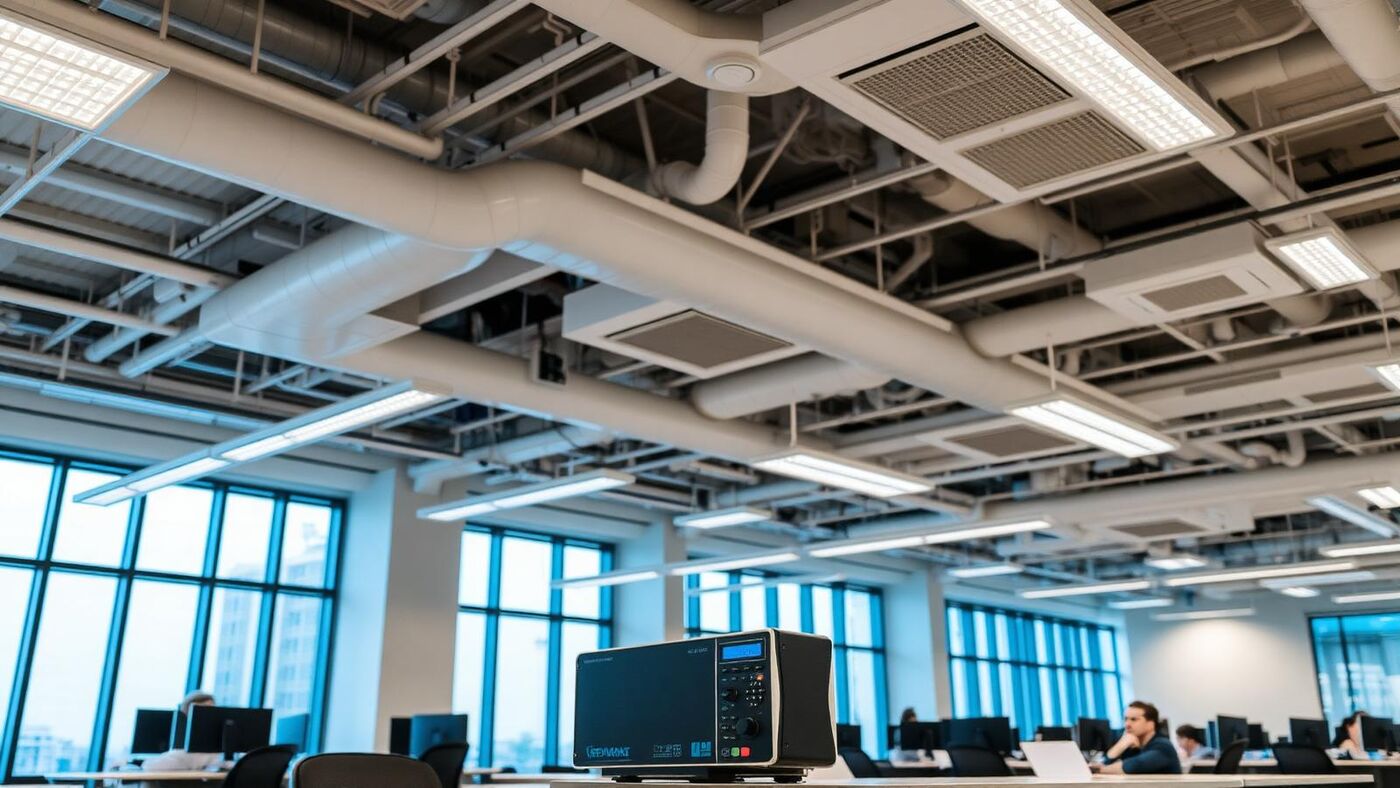
CO₂ Monitoring as a Ventilation Indicator
Independent indoor air quality assessors · Since 1999
CO₂ monitoring shows how effectively outdoor air dilutes the carbon dioxide produced by people in an occupied room. It is a practical indicator of ventilation relative to occupancy, especially in offices, meeting rooms, classrooms and other spaces where people are the main indoor source. Green Air Monitoring logs patterns through normal use and interprets them with occupancy and plant operation, rather than using one spot reading to describe a whole building.
Established 1999 · 2,500+ assessments · SafeContractor approved · BOHS Affiliate Member · London & South East
Why CO₂ reflects occupancy and ventilation
People exhale carbon dioxide, so concentration generally rises when an occupied space receives too little outdoor air for the number of people present. The pattern can reveal a room that fills faster than ventilation responds, plant that starts late, or an afternoon accumulation after several booked meetings. Outdoor concentration, room volume, occupancy and ventilation mode all affect interpretation. CO₂ is therefore most useful when the logger record is paired with room-use information rather than judged as an isolated number.
Logging approach and duration
We place calibrated non-dispersive infrared loggers in representative breathing-zone positions, away from open windows, supply grilles and a person’s immediate breath unless a local effect is being studied. Logging intervals are chosen to show room changes without producing meaningless noise. Deployment covers normal occupied periods and, where useful, unoccupied start-up or decay afterwards. The duration depends on weekly occupancy, room booking and the variability the client needs to understand. An outdoor or low-occupancy reference may be added to support interpretation.
Using the HSE indicator
HSE guidance treats CO₂ that is consistently above 1,500 ppm in an occupied room as a sign of poor ventilation. The word consistently matters: a brief peak, a faulty placement or an unrecorded crowd cannot be interpreted like a repeated occupied pattern. We show when the indicator was reached, how long the pattern lasted, which rooms were affected and what occupancy or ventilation information was available. This supports a proportionate operational or engineering review rather than a building-wide conclusion from one location.
Patterns found in working buildings
Meeting rooms can rise quickly during back-to-back bookings and recover when doors open or mechanical supply catches up. Morning data may show occupation beginning before the ventilation schedule. Afternoon accumulation can indicate that a steady supply is not matching sustained use. Differences between adjacent rooms may reflect separate controls, occupancy or door positions. Graphs are aligned with known events so facilities teams can test changes to schedules, booking limits or controls with the HVAC contractor.
What CO₂ cannot tell you
CO₂ does not measure airflow volume directly and cannot identify particulates, VOCs, formaldehyde, mould or a specific contaminant source. A low value does not prove that every aspect of air quality is satisfactory, and an elevated value does not diagnose a mechanical fault. Where the question needs a more detailed CO₂-based review across occupied areas, our Fresh Air Supply Assessment links logging to zones and operating information. Suspected plant faults are investigated by the HVAC contractor.
Limitations and what this assessment cannot tell you
- CO₂ indicates ventilation relative to occupancy and is not a direct airflow measurement
- The record depends on representative occupancy and suitable logger placement
- CO₂ does not identify other indoor pollutants
- Mechanical diagnosis and adjustment remain with the HVAC contractor
What your report includes
- Rooms, occupancy and ventilation context
- Logger details, positions, intervals and deployment period
- Time-series CO₂ graphs for each location
- Comparison with the HSE 1,500 ppm indicator
- Morning, meeting-room and afternoon patterns
- Operational checks and HVAC referral points
- Recommended repeat monitoring where appropriate
Related indoor air quality services
Frequently Asked Questions
Need Indoor Air Quality Testing?
Get a no-obligation quote. We provide IAQ testing, ventilation assessment and environmental monitoring across London and the South East.