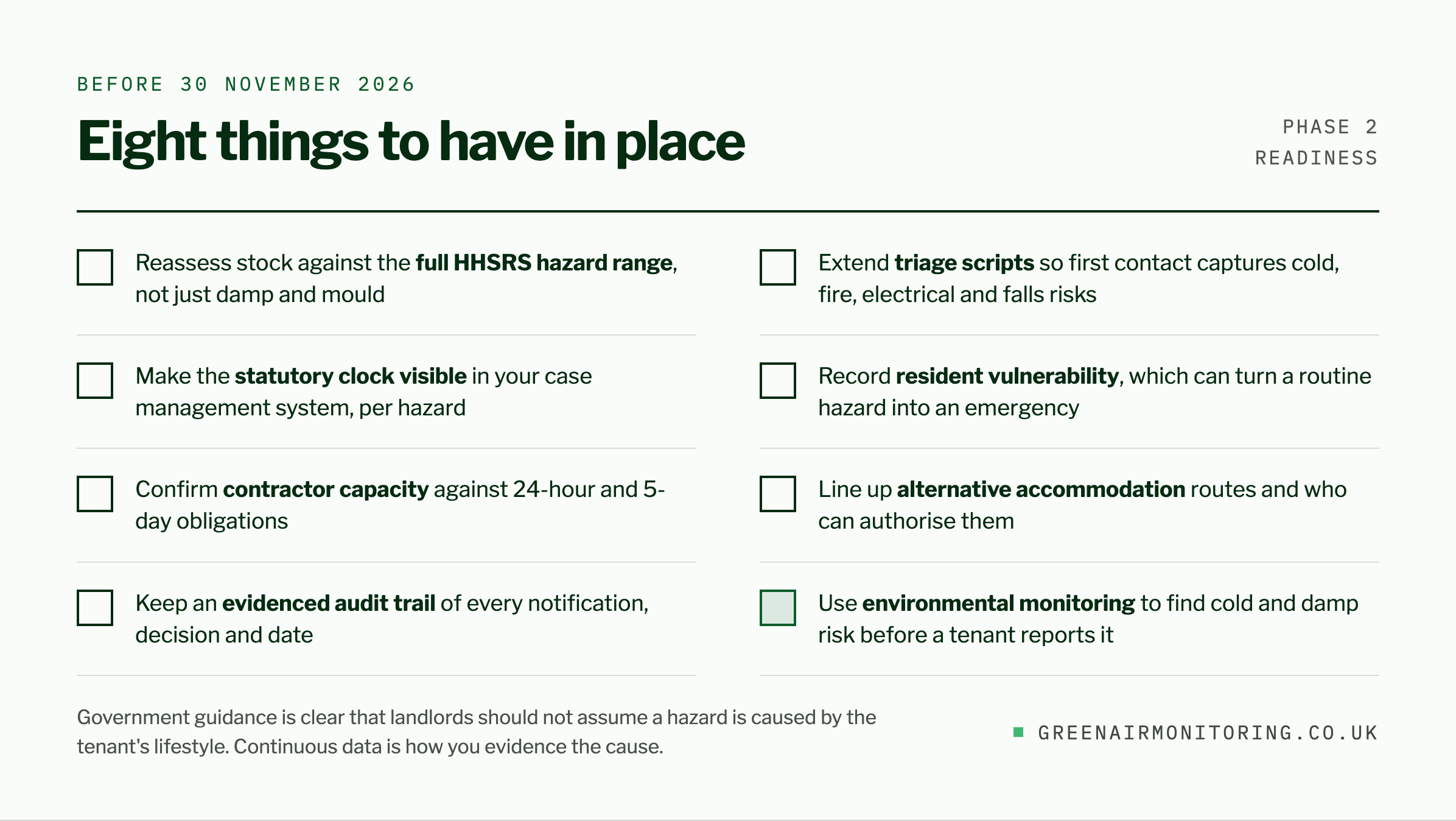
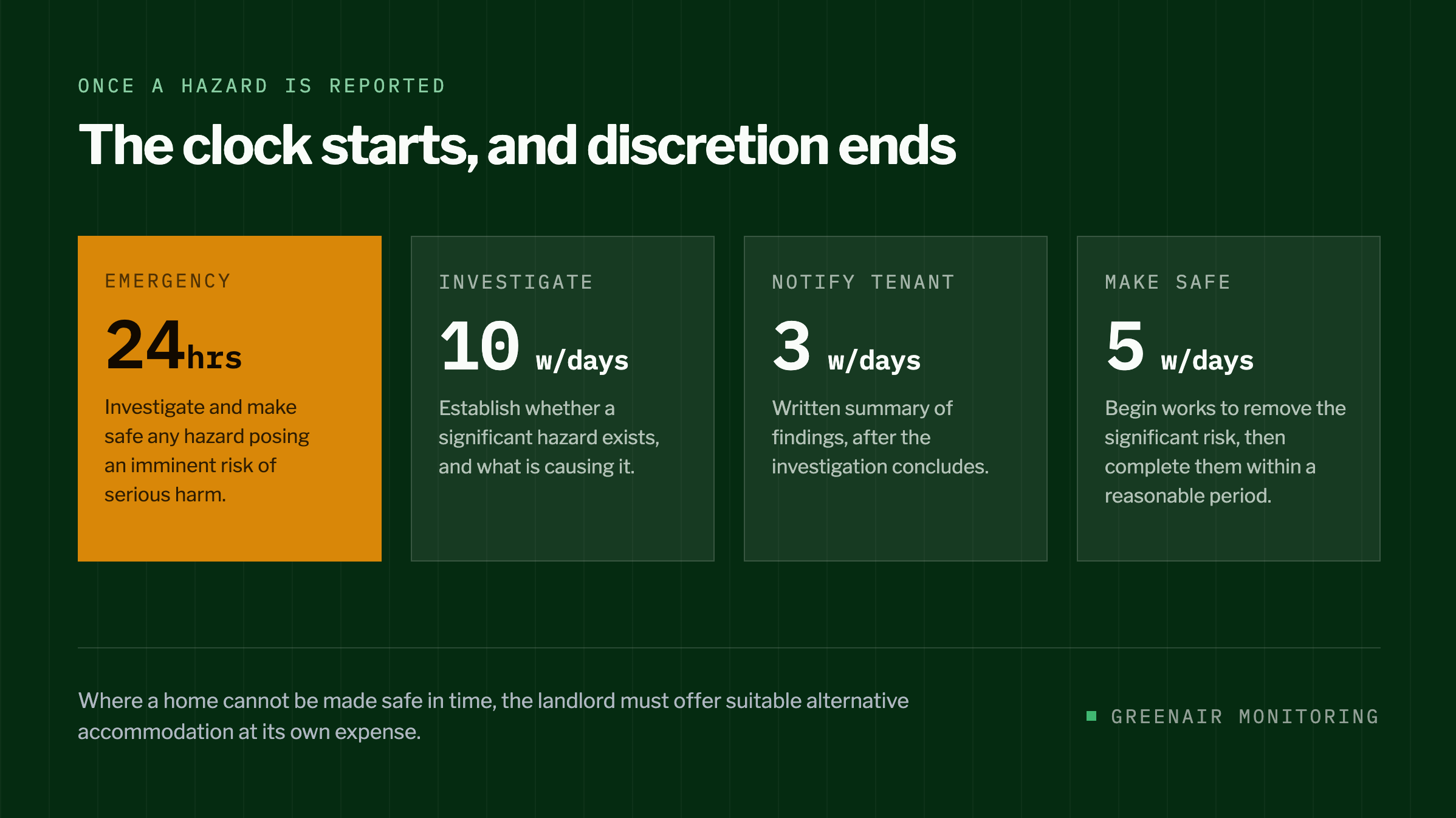
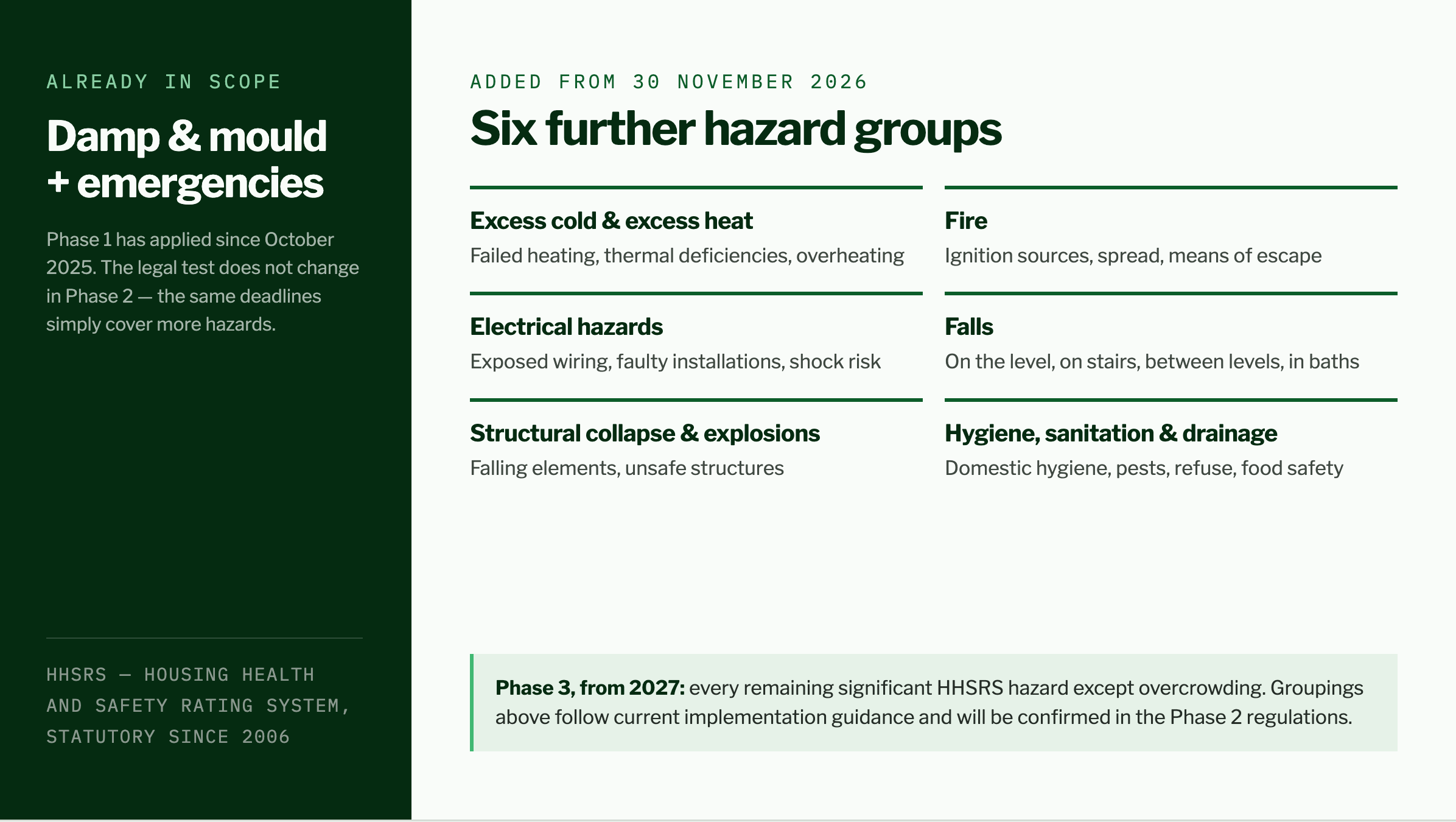
Phase 2 of Awaab's Law takes effect on 30 November 2026. The change obliges social landlords and those managing social housing to take quicker, documented action on reports of damp and mould. The deadline is a clear signal that visual inspection alone will not always be enough: building managers must be able to show timely, competent investigation and, where appropriate, objective sampling to support remediation decisions.
Our team treats buildings as systems and approaches mould as a managed building-environment issue. This short briefing explains what landlords should expect from Phase 2, why spore-trap air sampling frequently provides the missing evidence, and how to prepare investigation records that stand up to scrutiny.
What Phase 2 requires
Phase 2 formalises an expectation of faster response and clearer record keeping in cases of damp and mould in social housing. The measure affects around 4 million social housing tenants and shifts emphasis from ad hoc visual checks to documented, proportionate investigation where occupants report problems.
While the legislation sets the duty, the evidence that demonstrates timely and reasonable landlord action will be documentary: time-stamped inspection notes and photographs, moisture readings, arranged investigations, laboratory reports and remediation records. The Department for Levelling Up, Housing and Communities sets the policy framework for Awaab's Law and landlords should interpret Phase 2 in line with official guidance and their statutory duties.
Independent, contemporaneous evidence is the most persuasive record in demonstrating that an organisation acted appropriately and within a reasonable timeframe when a tenant raised concerns.
Why spore-trap sampling matters
Visual inspection identifies visible mould and potential moisture sources but it does not quantify airborne exposure or distinguish background spores from active contamination. Spore-trap air sampling provides objective, time-stamped data on airborne fungal spores that supports clinical, legal and operational decisions.
- Objectivity: Laboratory-counted spore concentrations give a numeric baseline that can be compared with later samples or with external reference conditions.
- Context: Paired indoor and outdoor samples show whether indoor counts are elevated relative to ambient outdoor levels.
- Forensic value: A professionally collected spore-trap sample, with an unbroken chain of custody and analysis by an accredited laboratory, is evidence that carries weight where the timing of action is contested.
Sampling is not a silver bullet. Interpretation requires experienced occupational hygienists or competent surveyors and must be combined with moisture mapping, building fabric inspection and consideration of ventilation. Guidance from the British Occupational Hygiene Society (BOHS) and the UK Health Security Agency (UKHSA) offers useful frameworks for sampling strategy and health risk interpretation.
Building robust mould evidence
Documented investigation is a sequence, not a single action. The following practical steps reduce ambiguity and demonstrate a landlord acted with appropriate speed and competence.
- Triage and record intake immediately - note the date and time of the tenant report, symptoms, affected locations and any urgent safety concerns.
- Perform a prompt visual and moisture inspection - take dated photographs, surface moisture readings and an initial assessment of likely causes (condensation, leaks, rising damp).
- Commission targeted investigations - where the visual inspection suggests unresolved or extensive mould, arrange spore-trap air sampling and, where relevant, surface sampling or material analysis before remedial works begin. If immediate remediation is necessary for safety, record that decision and take remedial photos and notes.
- Use accredited laboratories and competent analysts - ensure analyses are performed by UKAS-accredited laboratories or equivalent and that interpretation is provided by consultants with demonstrable competence in indoor air quality and mould assessment.
- Document remediation and verification - record the scope of works, dates, contractors, and verification sampling or inspection after remediation. Retain all reports, chain-of-custody forms and correspondence.
- Review ventilation and building defects - treat mould as a symptom of a building-system problem; document planned ventilation or fabric repairs and timescales for completion.
- Keep a clear audit trail - maintain a continuous record from tenant report through investigation, remediation and follow-up. That trail is the clearest proof you acted promptly and responsibly under Phase 2.
Where spore-trap sampling is used, the timing matters. A pre-remediation sample creates the strongest evidence of exposure and can be compared with post-remediation sampling to show effective clearance. If sampling cannot be conducted before urgent works, contemporaneous notes and immediate post-remediation verification will still strengthen the record.
For technical guidance on sampling methods and practitioner competence, refer to BOHS and UKHSA materials. For laboratory accreditation, look for ISO/IEC 17025 accreditation via the UK Accreditation Service (UKAS).
Key takeaways
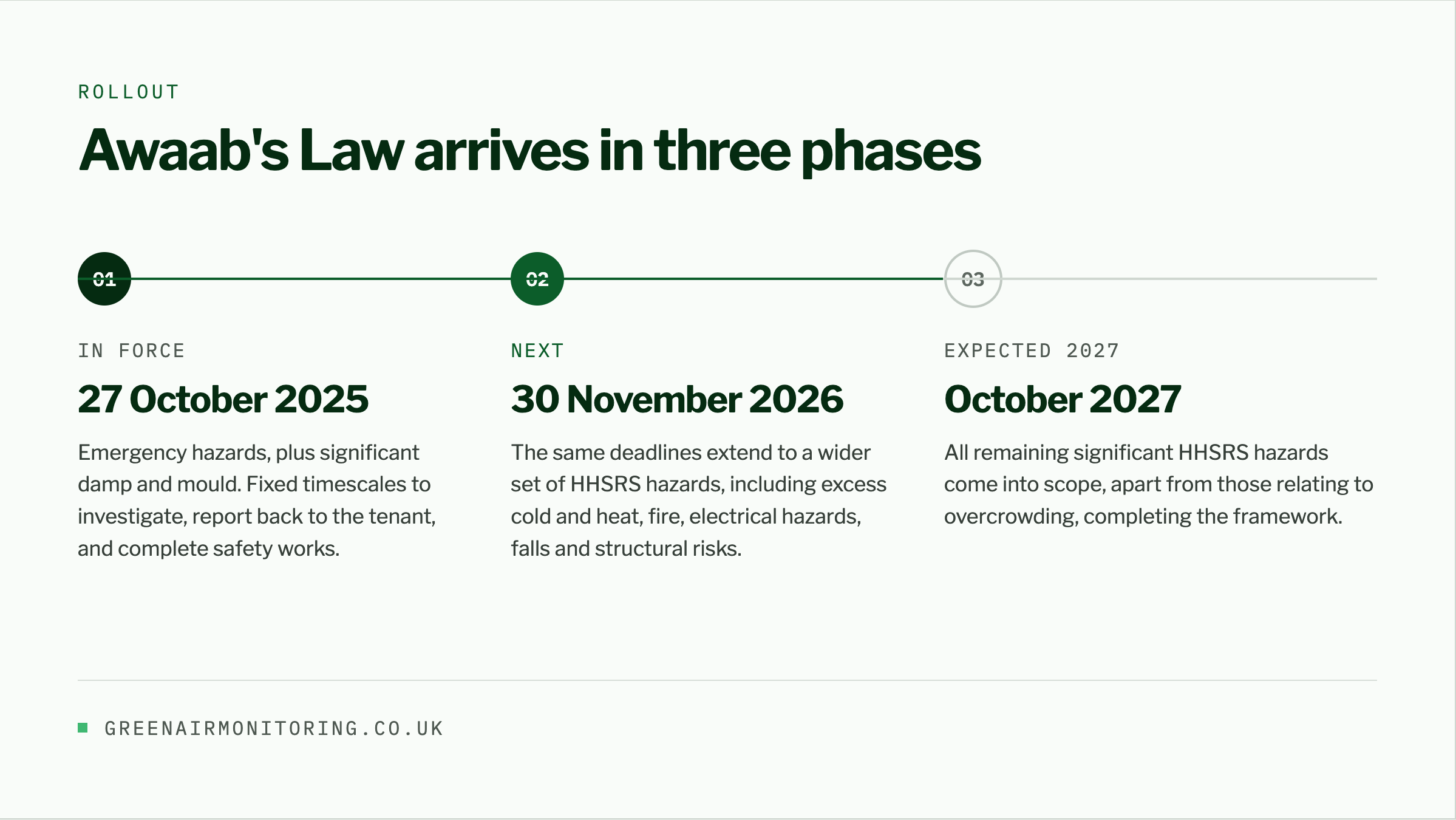
- Phase 2 of Awaab's Law takes effect on 30 November 2026 and increases the need for rapid, documented action on damp and mould.
- Visual inspection alone is often insufficient; spore-trap air sampling provides objective, time-stamped evidence that helps demonstrate timely action.
- Evidence quality depends on method, chain of custody, laboratory accreditation and competent interpretation.
- Maintain an audit trail from initial report through investigation, remediation and verification to show compliance with the new expectations.
- Follow sector guidance from the Department for Levelling Up, Housing and Communities, UKHSA and BOHS and use UKAS-accredited laboratories where analysis is required.