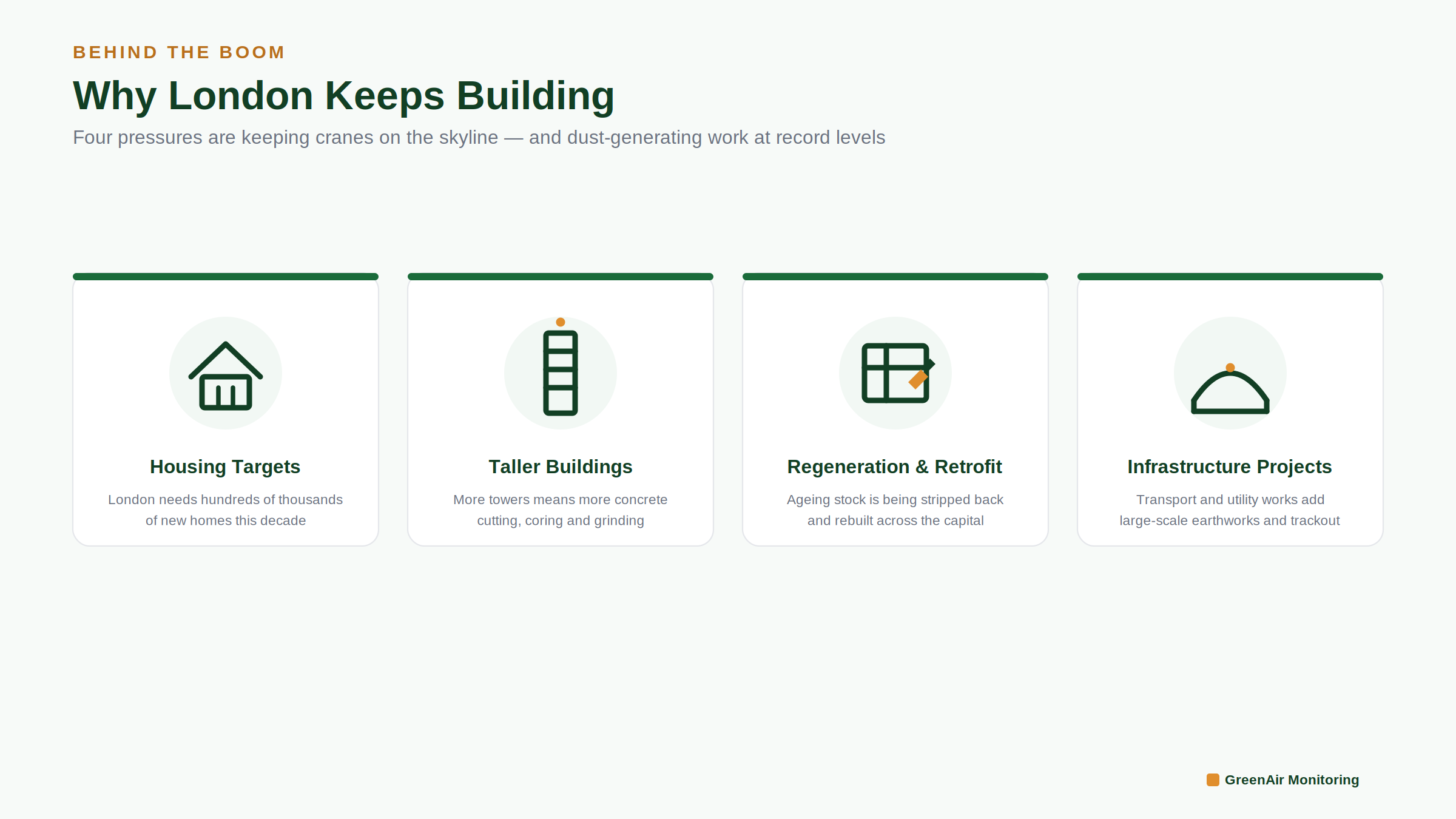
Large-scale construction and demolition in London is creating a persistent, low-level nuisance: dust at site boundaries. Where developments sit next to schools, hospitals and residential blocks, that dust becomes a regulatory and reputational issue as well as a comfort and health concern for occupants. Recent action by the Environment Agency against a waste and recycling site shows the consequences when permit conditions and controls fail. Our team outlines what boundary teams, developers and contractors should consider to reduce risk and satisfy permit and planning requirements.
Why boundaries matter for dust
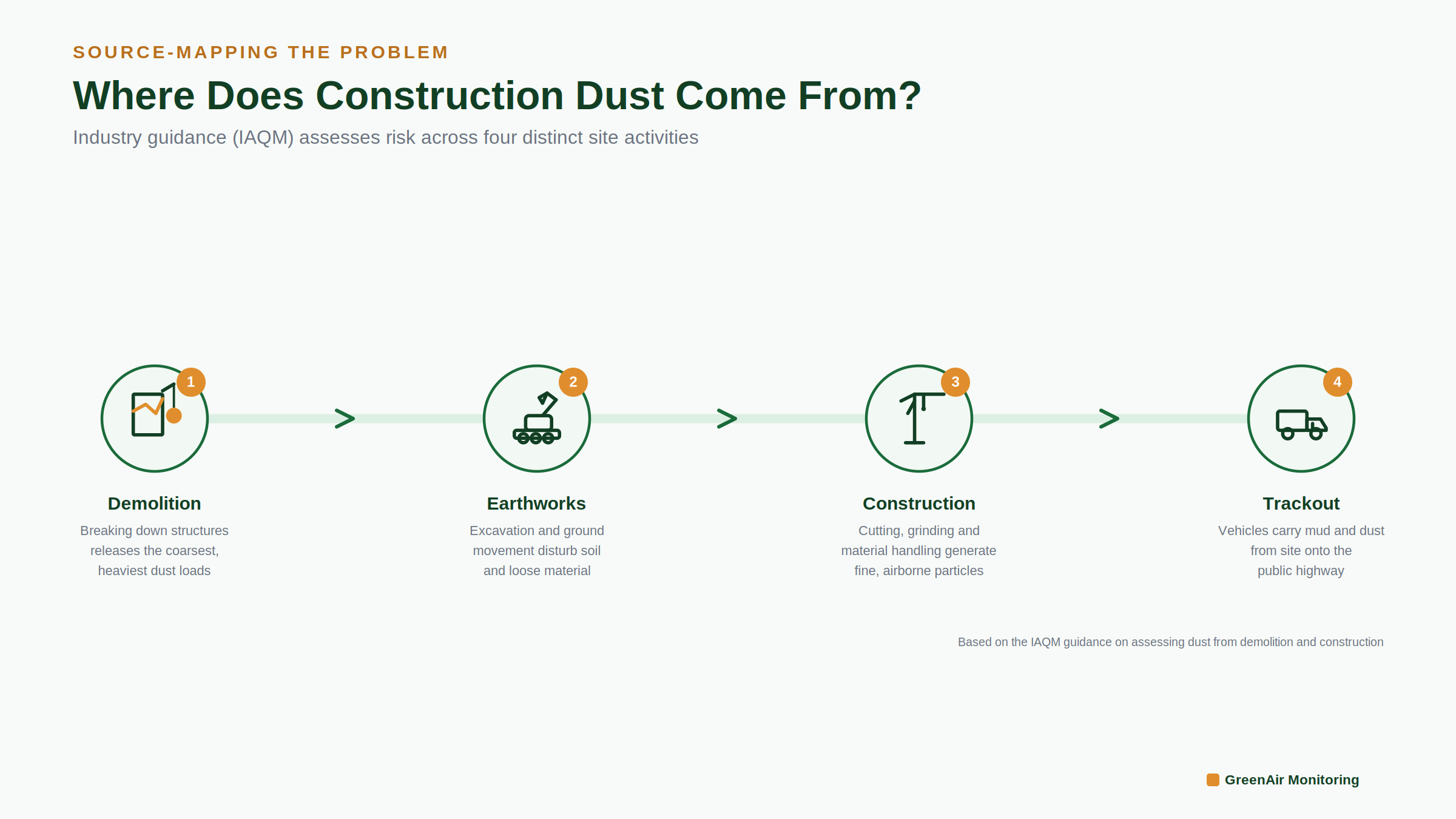
Boundaries are where site activity meets real people. Dust released on site does not remain an operational statistic; it deposits on windowsills, obscures façades, affects indoor air when it infiltrates buildings, and generates complaints that can trigger enforcement. For sites close to sensitive receptors the stakes are higher: interruptions to school activities, interference with patient care, and nuisance for residents can all escalate quickly.
Regulatory attention tends to focus on boundaries because that is where pollution crosses from a private site into the public realm. The Environment Agency, local planning authorities and environmental health teams often use boundary measurements and complaint logs when assessing whether permit conditions are breached. That is why monitoring at the boundary must be robust, defensible and tied to operational controls.
Practical monitoring approaches for sites
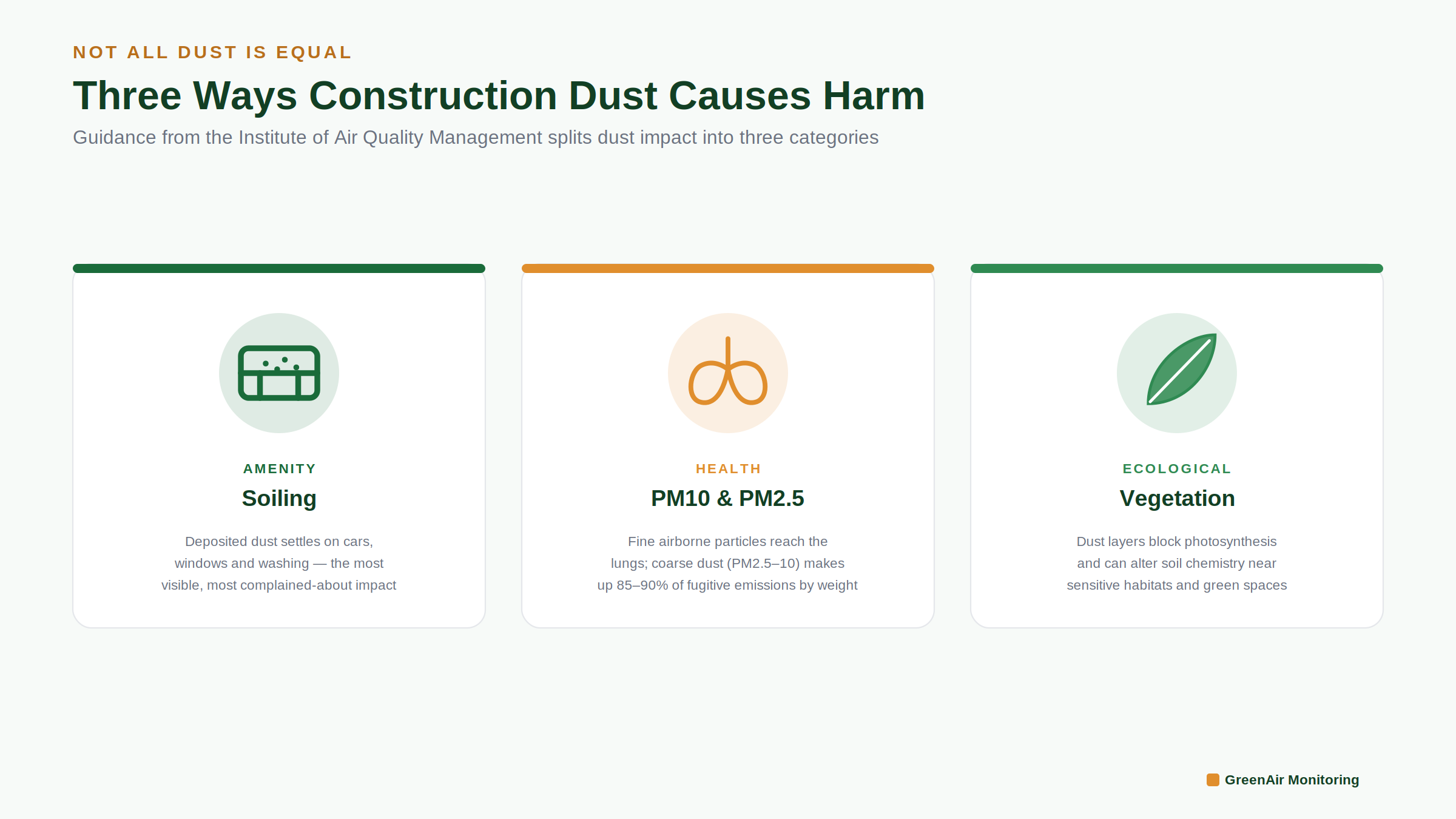
Monitoring is part measurement and part management. A pragmatic programme mixes methods to capture both deposition and airborne concentration, and to provide evidence linked to operations and weather.
- Baseline and siting - Establish a baseline before major works start and place instruments where receptors are worst affected, not where they are most convenient. Consider wind direction and likely dust pathways.
- Deposition gauges - Simple passive gauges record deposited dust (commonly expressed as mg/m2/day). They are useful for visualising accumulation and for long-term trend evidence used by regulators.
- Real-time PM monitors - Optical PM10 and PM2.5 monitors provide minute-by-minute trends and can trigger site action when concentrations rise. Ensure instruments are calibrated and, where possible, co-located with a reference or checked against a higher-grade analyser to validate readings.
- Complaints-linked monitoring - When complaints occur, targeted short-term monitoring co-located with deposition gauges and meteorological sensors helps establish whether the site was the likely source.
- Meteorological data - Wind speed and direction are essential for interpreting results. Correlating dust events with wind records makes a monitoring dataset much more persuasive to regulators and communities.
Guidance from the Institute of Air Quality Management (IAQM) and operational advice from the Environment Agency provide useful frameworks for designing monitoring programmes. Match the intensity of monitoring to the sensitivity of receptors and to the scale and phase of works.
Managing permit conditions and community complaints
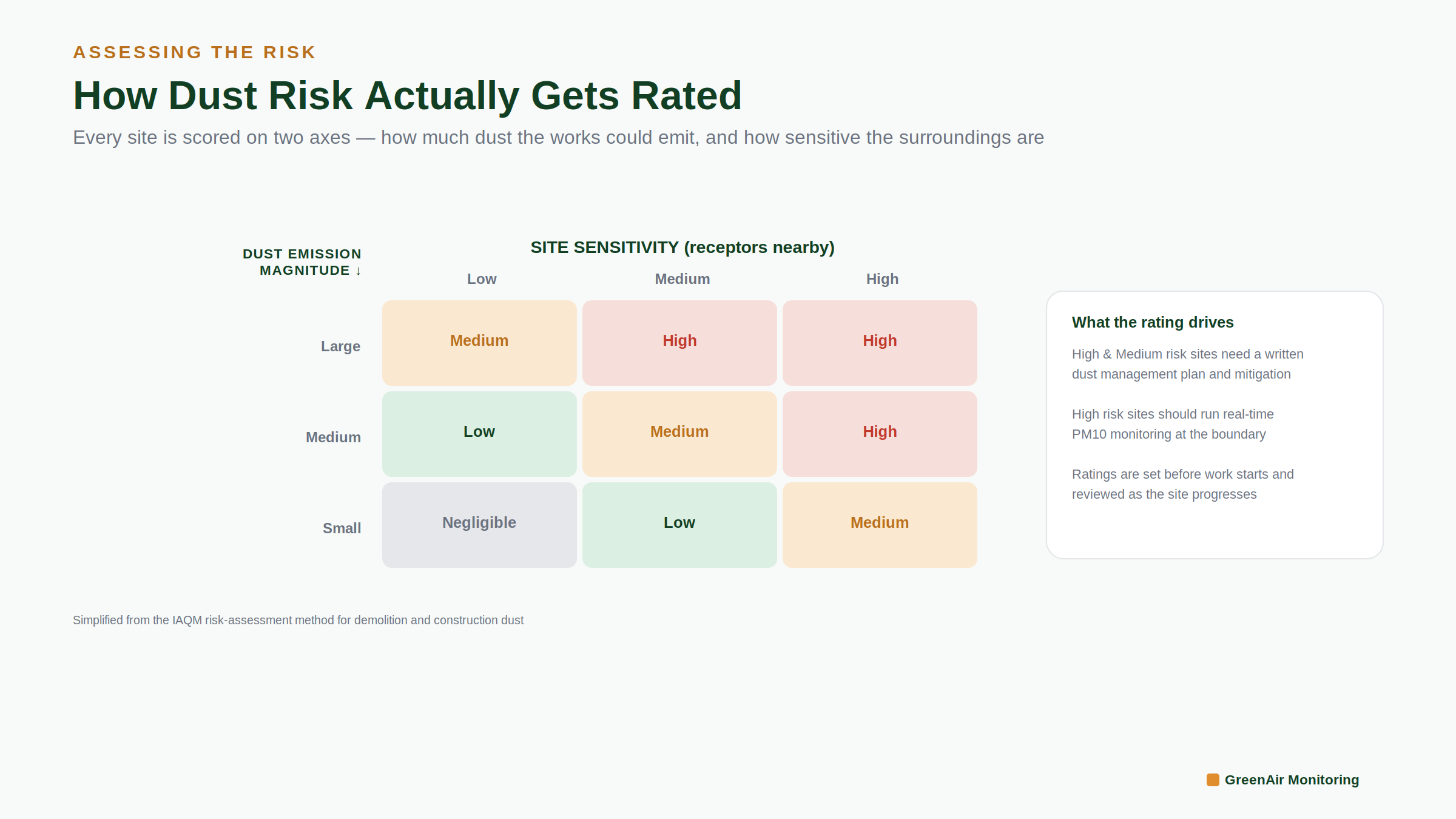
Permits and planning conditions increasingly require dust management plans, monitoring and prompt responses to exceedances or complaints. The Environment Agency has demonstrated that poor compliance can lead to swift enforcement, including operational stoppages, and those sanctions can be applied to waste-handling facilities as readily as to construction sites.
Key management elements are:
- Action triggers - Define clear trigger levels for monitoring instruments that require specified site actions, for example increasing suppression, halting specific activities or moving operations away from the boundary.
- Operational controls - Maintain robust measures such as water suppression, sheeting, covered stockpiles, wheel washing and wheel-out controls, plus good housekeeping to limit wind-blown material.
- Record-keeping - Keep time-stamped logs of monitoring data, meteorological conditions, site activities, complaints and remedial actions. Good records are critical in the event of an investigation.
- Transparency - Where planning conditions require it, make monitoring data available to stakeholders. A clearly explained dataset reduces speculation and helps defuse community tensions.
Operationally, the most effective programmes integrate monitoring into daily site management. Monitoring should not be an afterthought or a purely defensive exercise; it is a tool for managing activities so they are demonstrably compliant and to reduce the likelihood of complaints that might trigger regulatory attention.
Key takeaways for site teams and planners
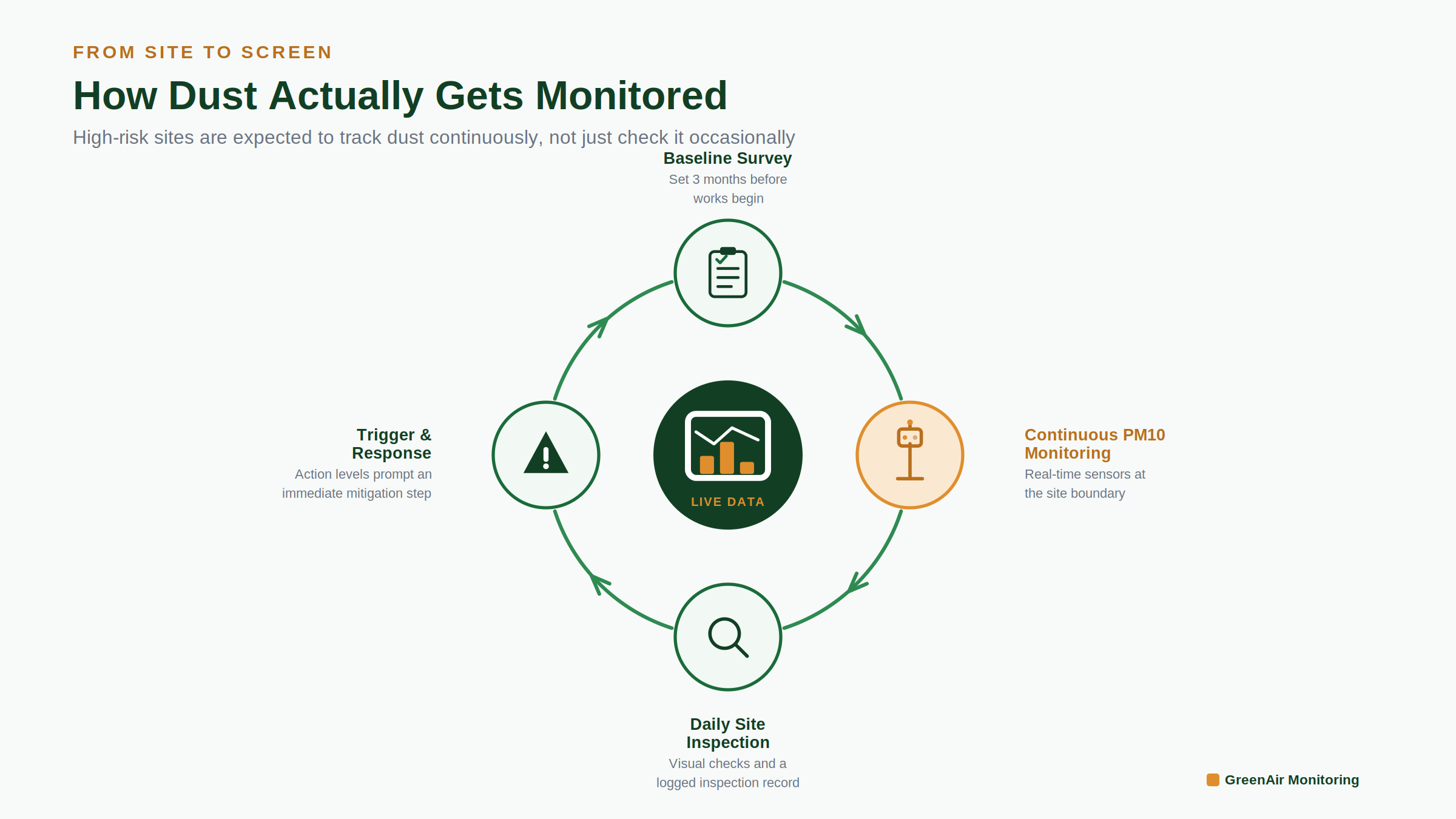
Boundary dust monitoring is a practical requirement and a risk-management tool. The Environment Agency and local authorities will use boundary evidence and complaint records when assessing compliance. Sites that plan monitoring thoughtfully, tie triggers to defined actions, and maintain clear records reduce regulatory risk and community friction.
- Place monitoring where receptors will be affected and establish a pre-work baseline.
- Use a mix of deposition gauges and real-time PM monitors, supported by meteorological data.
- Define action triggers and ensure operational controls can be mobilised quickly.
- Keep comprehensive, time-stamped records to demonstrate compliance and to explain events to regulators and the public.
Good monitoring is not a substitute for good site practice. It is evidence that the controls are working and a way to spot issues before they become enforced stoppages or cause lasting harm to neighbours and reputation.