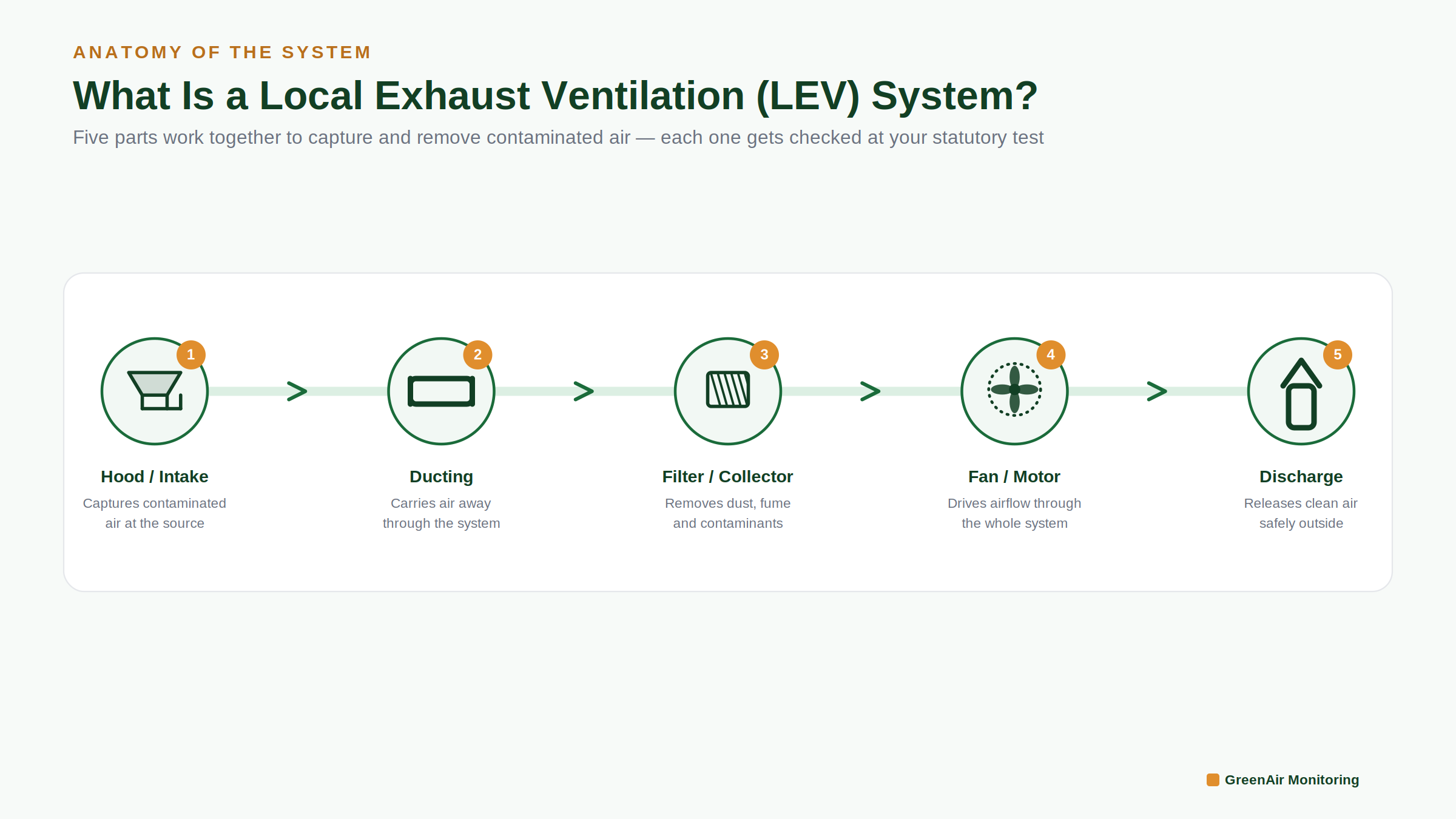
Regulation 9 of the Control of Substances Hazardous to Health Regulations (COSHH) places a clear duty on employers to ensure local exhaust ventilation (LEV) is effective. A Thorough Examination and Test, commonly abbreviated to TExT, must take place at least every 14 months. That timescale is statutory, not optional, and the Health and Safety Executive (HSE) continues to take enforcement action where employers have failed to control dust and other airborne hazards.
Our team approaches LEV as a managed element of a building's health and safety system. TExT is a compliance milestone and an operational review: it confirms that the system continues to protect people and provides the evidence employers need to demonstrate they are meeting their duty of care.
HSE guidance on LEV and TExT explains the legal basis and the expected content of examinations. See HSE for current guidance on LEV and COSHH responsibilities: HSE LEV guidance and HSE COSHH.
What Regulation 9 Requires
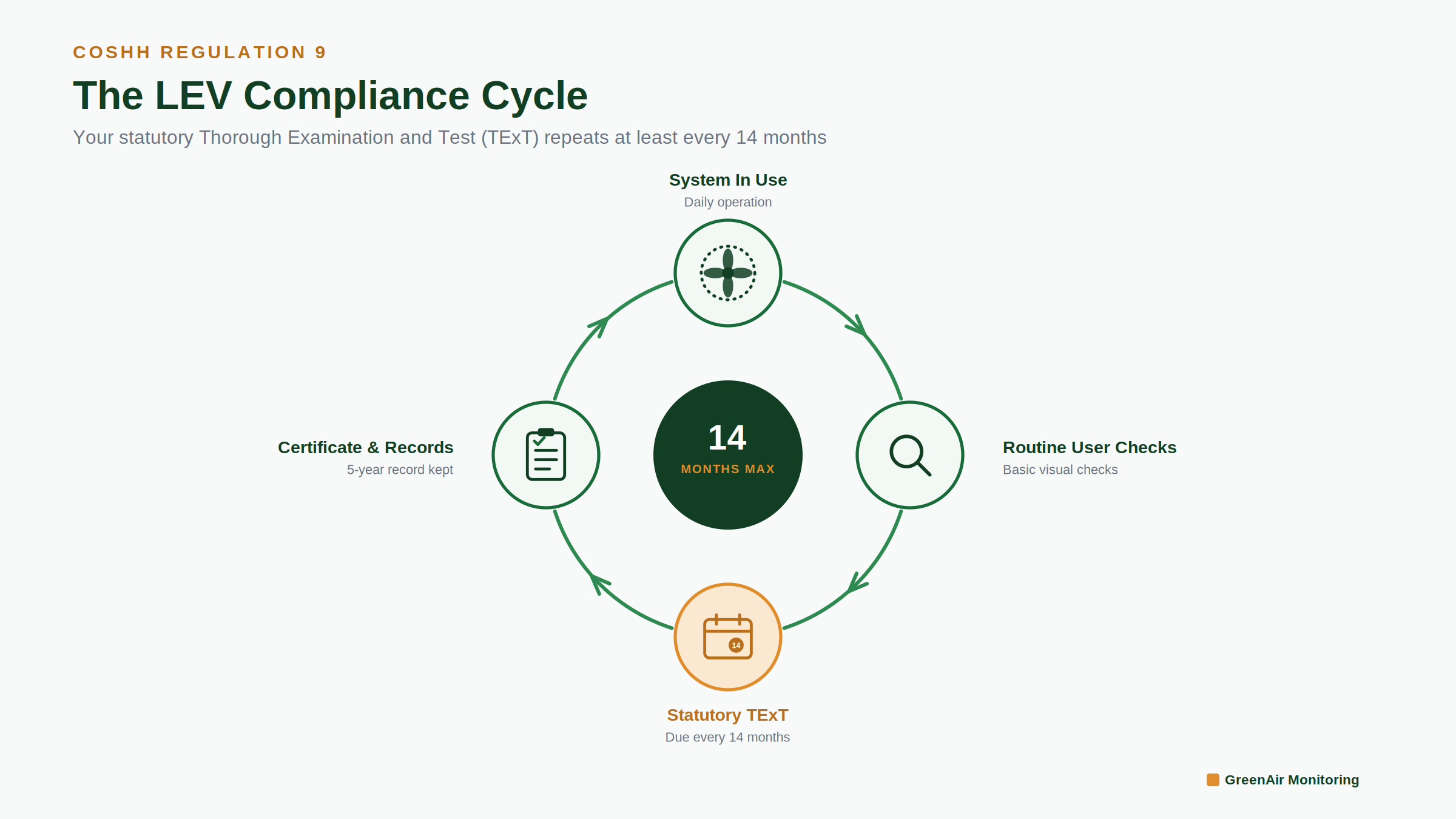
Regulation 9 requires employers to ensure that any control measure provided to prevent exposure to hazardous substances is maintained in an efficient state and in efficient working order. For LEV this is implemented through TExT at least every 14 months. The key legal points are:
- Frequency: a full TExT at least once every 14 months; more frequent checks may be necessary where risk, use patterns or deterioration justify it.
- Competence: the examination and test must be carried out by a competent person who can assess both the physical condition of the system and its functional performance.
- Report and record: the person conducting the TExT must provide a written report that identifies defects and recommends remedial action. Employers should retain these records as evidence of compliance.
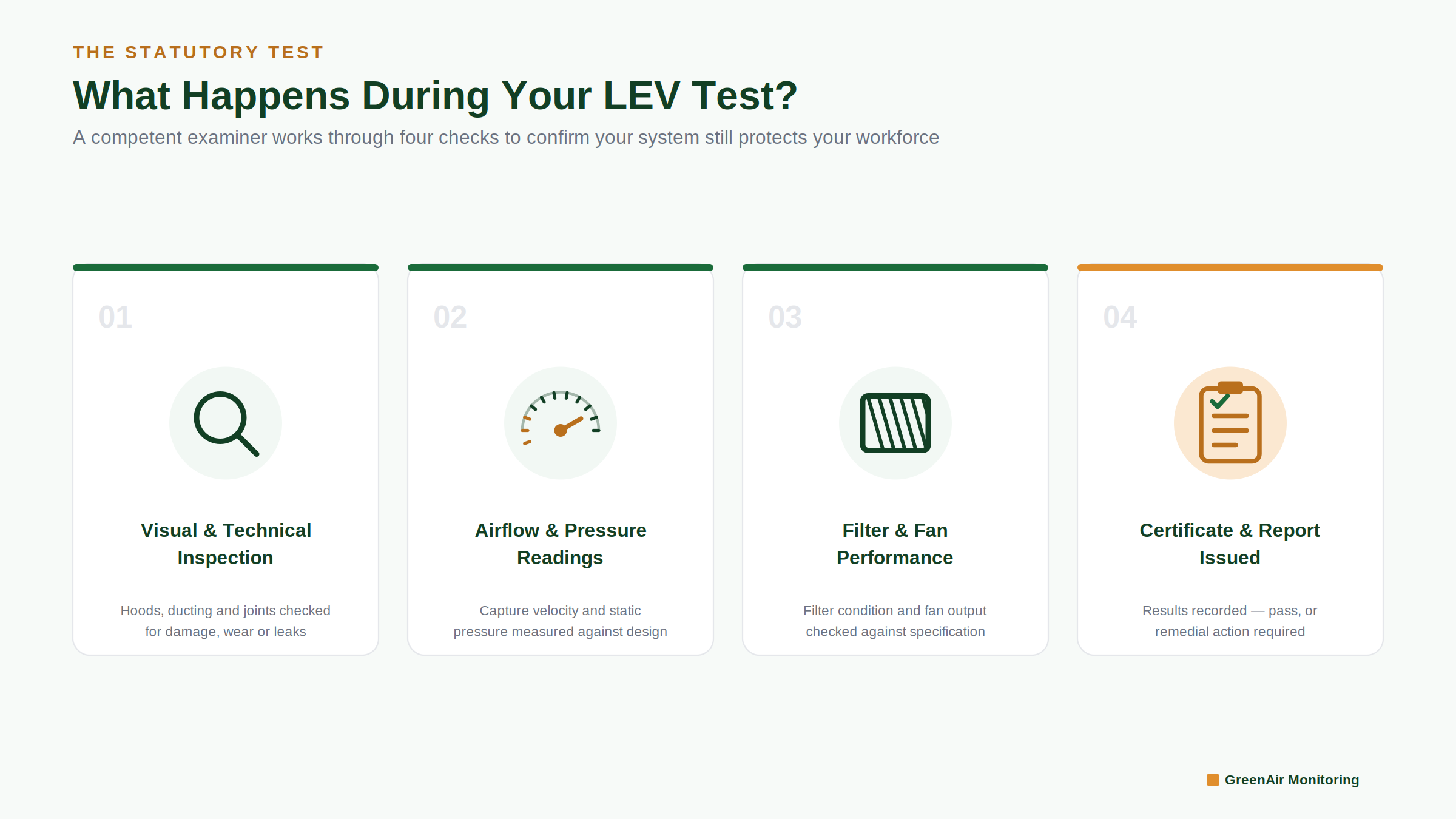
HSE sets out the expectations for what a TExT should cover: inspection of ductwork and hoods, testing of extract volumes and capture where appropriate, assessment of filters and cleaners, evaluation of fans and drives, and consideration of any change since the last test. The emphasis is on ensuring the system still performs for the hazards it was designed to control.
Enforcement and Business Risk
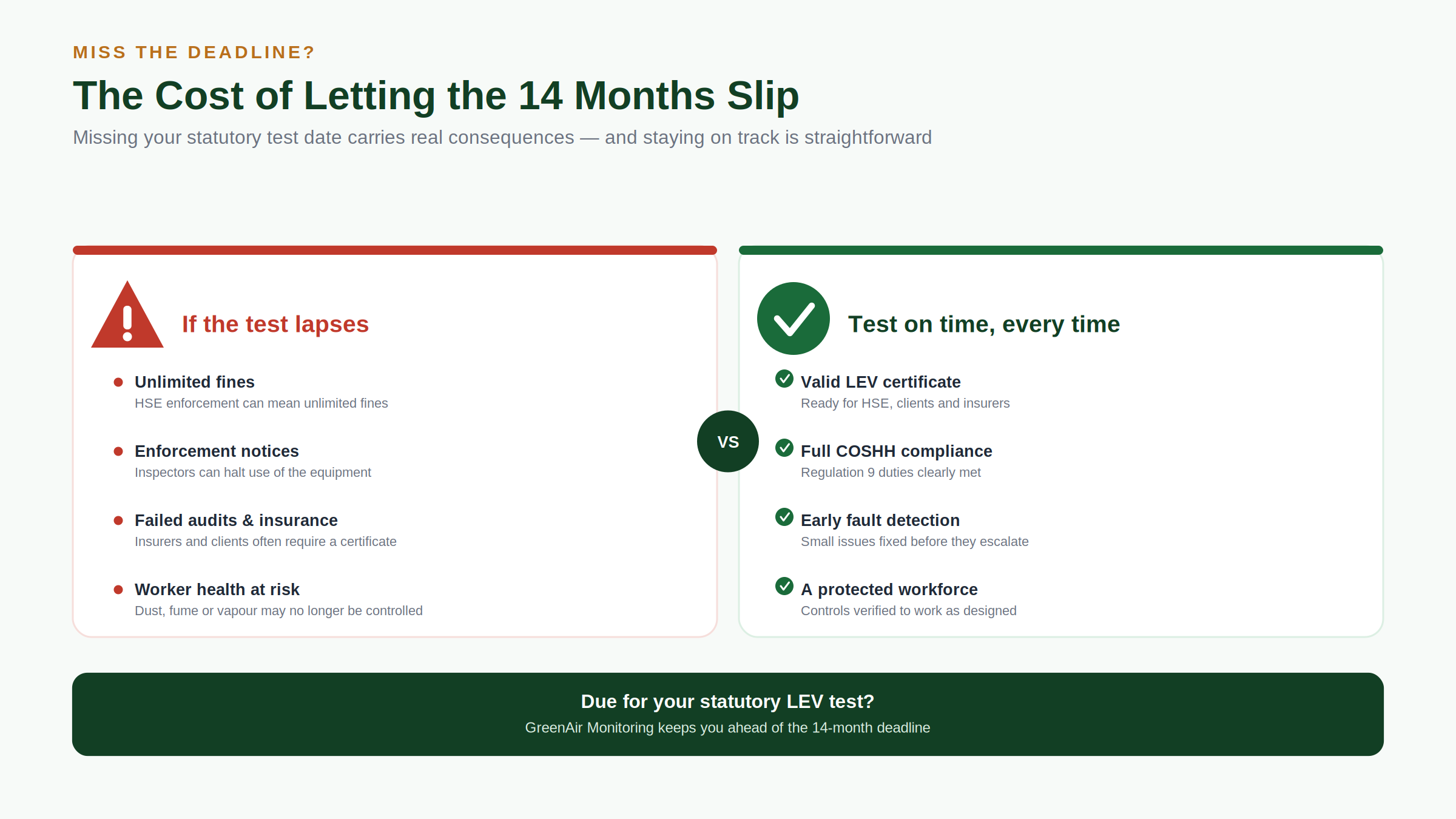
Failure to maintain LEV is not simply a paperwork issue. HSE enforcement activity demonstrates that employers remain at risk of prosecution when control measures fail and people are exposed to harmful dusts or fumes. Enforcement outcomes typically reflect three business risks.
- Health risk and liability: uncontrolled airborne contaminants can cause occupational disease that may only become apparent years later. That creates legal and compensation exposures for employers.
- Operational and financial impact: worker absence, reduced productivity and the cost of remedial works all follow from long-term poor control of airborne hazards.
- Regulatory and reputational damage: enforcement notices, fines and publicised prosecutions have clear reputational consequences for companies and can affect contracts and insurance discussions.
HSE continues to publish enforcement news and prosecution summaries that illustrate these themes; employers should review those materials to understand the kinds of failings that attract attention and penalty. See the HSE enforcement pages for examples and guidance.
Managing Compliance in Practice
Compliance with the 14-month requirement is straightforward to manage when LEV is treated as part of a building systems maintenance regime rather than an occasional check. Practical steps that our team recommends are:
- Assign responsibility: identify the person or role accountable for scheduling TExT, holding reports and tracking remedial work.
- Use competent testers: choose testers who can demonstrate experience and the appropriate instruments and methods for measuring performance. Ask for references and examples of TExT reports so you understand the level of detail provided.
- Integrate with maintenance: link TExT scheduling to your planned preventive maintenance, filter replacement cycles and any change control process so that modifications to processes or plant trigger earlier checks.
- Act promptly on defects: the TExT report should set out defects and recommended actions. Treat these as safety-critical tasks and record progress and verification of completed works.
- Keep clear records: retain TExT reports, risk assessments and evidence of remedial actions. Records are the primary evidence of compliance during inspections or prosecutions.
- Review interval and risk: review the 14-month interval in the light of actual use, process changes, and incident history. High-risk operations may justify more frequent functional tests.
Beyond these steps, consider using TExT reports to inform workplace risk assessments and training. Reports often identify operational or user issues that can be addressed through changed procedures, housekeeping or local controls.
Key takeaways
- Regulation 9 of COSHH requires a Thorough Examination and Test of LEV at least every 14 months; this is a legal duty, not optional guidance.
- TExT must be performed by a competent person and provide a written report recording defects and remedial recommendations.
- Failure to maintain LEV attracts health, financial and reputational risks and remains a focus for HSE enforcement.
- Manage TExT as part of an integrated maintenance and risk-management system: assign responsibility, hire competent testers, act promptly on defects and keep records.
- Review testing frequency where processes or risks change; more frequent checks are often justified in high-risk environments.
Viewing the 14-month TExT as both a compliance requirement and an operational control helps ensure LEV continues to protect people and limits the business consequences of avoidable exposure.