Complaints about headaches, sore throats, eye irritation or persistent fatigue are a common trigger for HR and facilities teams. Those symptoms can result from many causes, but when several occupants report similar problems in the same space a structured, evidence-led response is required. Recent enforcement activity by the Health and Safety Executive (HSE) underlines that regulators take workplace exposures seriously: HSE action, including substantial fines where dust or other airborne hazards risk occupational asthma, demonstrates the duty of care employers must meet.
We use the term reactive investigation to describe a targeted, short-term programme of inspection and measurement that follows staff complaints. A reactive investigation is not an exercise in finding a single dramatic ''smoking gun''. It is a pragmatic diagnostic process designed to separate likely environmental causes from unrelated health or organisational factors, and to produce clear, actionable findings for building managers.
How a reactive investigation works
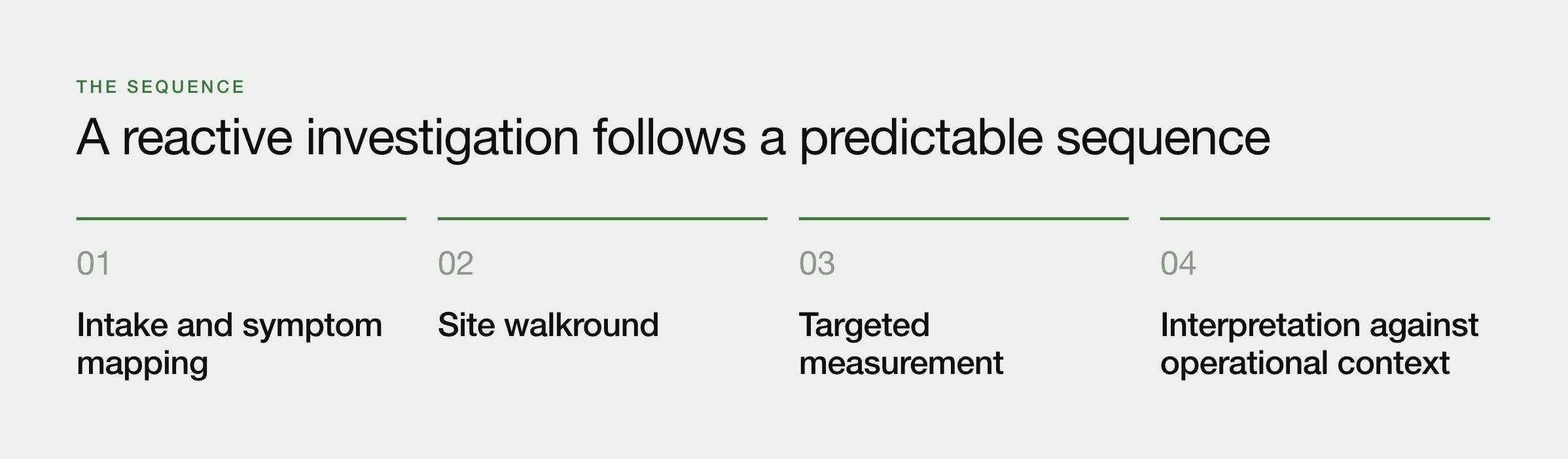
Reactive investigations follow a predictable sequence so results are reliable and defensible. Typical steps are:
- Intake and context: we review the pattern of complaints, occupancy schedules, recent works, maintenance records and any past air-quality data. That context narrows down probable causes.
- Walkthrough inspection: a systematic visual survey of the space and plant. We look for visible leaks, damp, poor housekeeping, obvious pollutant sources such as printers or solvent stores, and HVAC anomalies.
- Targeted measurement: short-term monitoring tailored to the complaint. That commonly includes CO2 to indicate ventilation effectiveness, temperature and relative humidity, particulate counts (PM2.5/PM10) where dust is suspected, and volatile organic compound screening. We select instruments and durations to answer the specific question rather than produce a vanity dataset.
- Ventilation performance checks: flow measurements at supply and extract grilles, smoke visualisation to show airflow patterns, and sometimes tracer-gas testing when precise air-change rates are required.
- Plant and fabric sampling: when indicated, surface or bulk samples from ducts, filters or suspect building fabric are taken. Duct cleanliness is typically evaluated in relation to BOHS guidance such as TR19.
- Interpretation in context: results are compared to relevant guidance and to the work patterns and symptoms reported. We report uncertainties and where further specialist assessment is required.
These steps usually take a few days to a few weeks to complete, depending on access, the need for laboratory analysis and whether follow-up visits are required.
Common findings and their causes
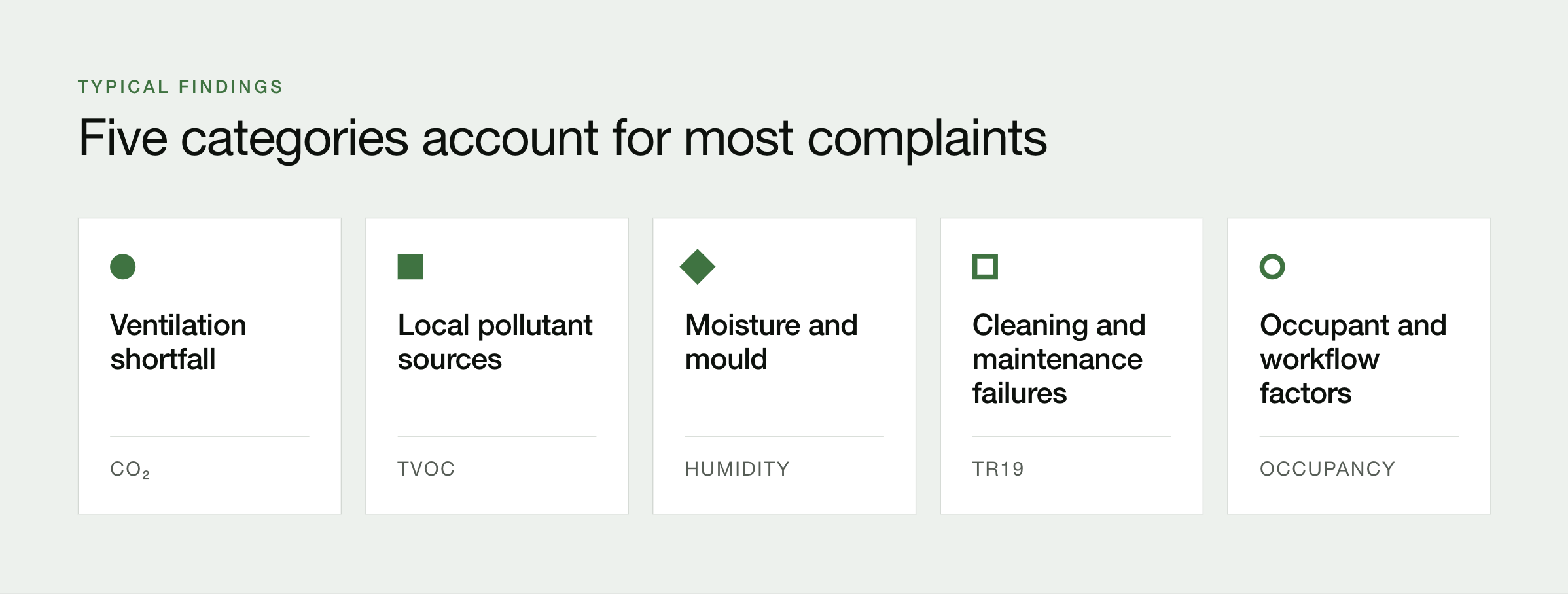
Reactive investigations most often identify one or more of the following situations. Each has different remedies and business implications.
- Insufficient ventilation relative to occupancy is a frequent finding. Elevated CO2 or stagnation shown by smoke testing points to inadequate fresh-air supply, which increases the concentration of human-derived pollutants and perceptions of stuffiness. Ventilation shortfalls are typically the result of incorrect balancing, failed plant, blocked inlets or changes in occupancy that were not accounted for.
- Local pollutant sources such as solvent-based cleaning, recent fit-out off-gassing, high‑use printing and copying equipment, or occasional maintenance activities can cause spikes of VOCs or irritant fumes that correlate with complaints.
- Accumulated dust and poor hygiene in ductwork can act as a reservoir of allergens or irritants. Where dust exposure is significant there is a demonstrable occupational risk. BOHS TR19 provides an established benchmark for assessing duct cleanliness, and HSE guidance recognises that failures in control of airborne dust can lead to enforcement action.
- Thermal comfort and humidity problems that both cause symptoms directly and create conditions that favour mould. Visible damp or mould growth requires building-fabric remediation as well as hygiene measures.
- Intermittent plant faults and operational issues such as timers, sensors or controls that switch to reduced ventilation outside occupied hours. These produce inconsistent exposures that complicate diagnosis.
- Non-environmental explanations include personal health issues, psychosocial factors, or infections. An investigation that finds no environmental exceedances is still a valid outcome because it prevents needless remedial spend and directs attention to other lines of enquiry.
Practical conclusions and business implications
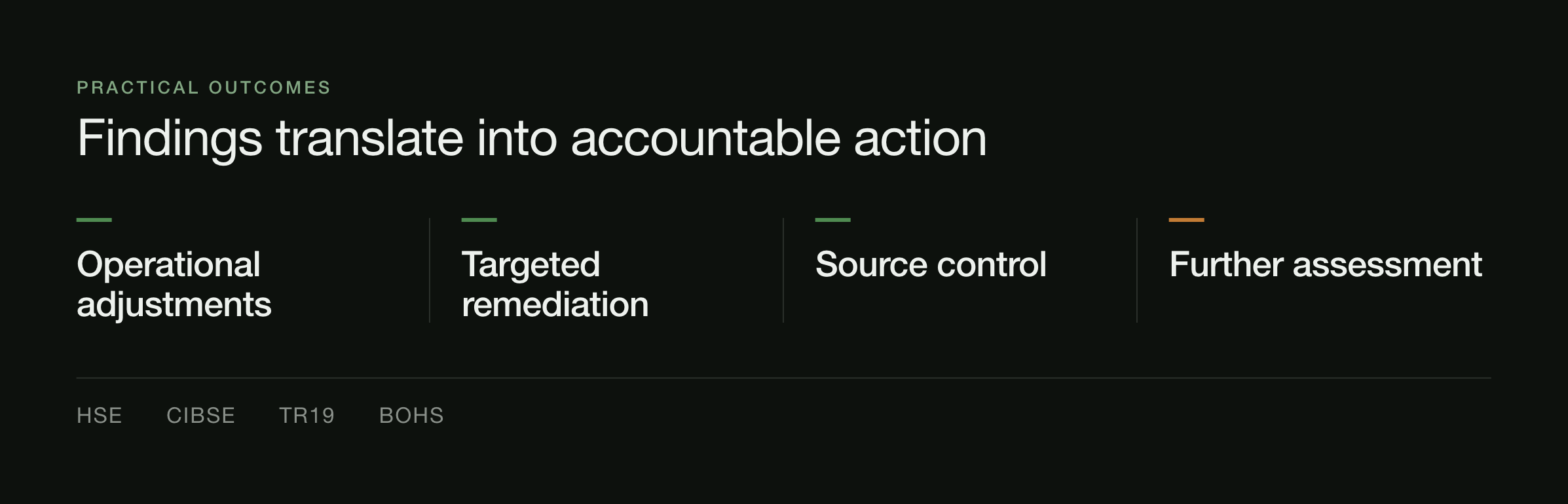
Findings from a reactive investigation are translated into a prioritised set of actions rather than a single prescription. Typical recommendations fall into these categories:
- Source control - remove, relocate or substitute offending equipment or chemicals; change cleaning products or schedules.
- Ventilation fixes - rebalance airflow, repair failed fans, clear blocked inlets and adjust controls to match occupancy patterns.
- Hygiene and maintenance - filter changes, targeted cleaning and ductwork remediation where TR19 assessment indicates unacceptable deposits.
- Environmental management - ongoing monitoring for CO2 or particulates, improved record keeping and planned reassessment after remedial works.
- Communication and governance - clear reporting to occupants and line managers, and documentation to satisfy duty of care and to reduce the risk of enforcement by HSE where exposures are significant.
From a business perspective, resolving confirmed environmental issues reduces complaints, supports staff wellbeing and productivity, and limits legal and regulatory risk. Conversely, ignoring recurrent, evidence-based findings can lead to increased absenteeism, reputational damage and, in some cases, regulatory enforcement. Employers benefit from treating IAQ as a managed building-system issue integrated with maintenance and occupational health rather than a one-off nuisance problem.
Where investigations identify no clear environmental hazard the report still has value: it documents the evidence that supports occupational-health decisions, helps avoid unnecessary remediation costs, and refocuses attention on alternative explanations.
Key takeaways
- Reactive investigations convert staff concerns into verifiable data and practical work priorities.
- Measurement focuses on ventilation performance, source identification, hygiene and plant condition rather than alarmist ''toxic air'' labels.
- Common outcomes include ventilation shortfalls, local pollutant sources, accumulated dust in ductwork and intermittent plant faults; BOHS TR19 is a recognised reference for duct cleanliness.
- Findings inform targeted remediation, reduce business risk and provide defensible records for duty of care and potential HSE scrutiny.
Evidence-led investigation and sensible, proportionate remediation are the most effective ways to restore occupant confidence and bring buildings back to expected performance.