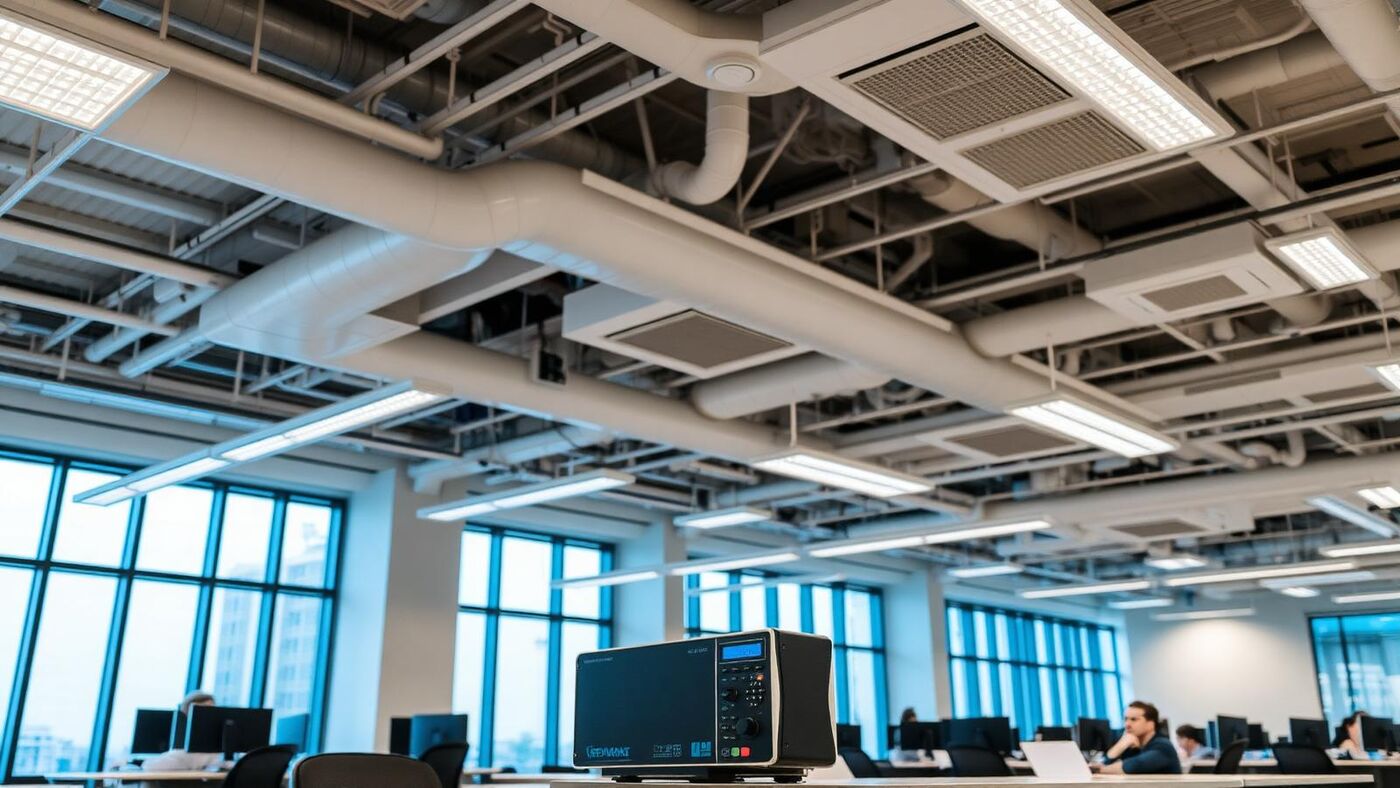
Dust Complaint Investigation
Independent indoor air quality investigators
Visible dust settling on desks, equipment or window ledges can come from several sources at once. Nearby refurbishment may introduce mineral particles; filters or ductwork may affect distribution; textiles and paper contribute fibres; outdoor material can enter through doors or ventilation; and cleaning practice influences where deposits remain visible. We combine observations, monitoring and targeted sampling to distinguish plausible sources and define the next useful action.
Established 1999 · 2,500+ assessments · SafeContractor approved · BOHS Affiliate Member · London & South East
What the dust pattern can show
The position, colour, texture and recurrence of deposits help shape the investigation. Dust concentrated below supply grilles raises different questions from debris beside a construction partition. A uniform fine layer across an office may relate to cleaning frequency, normal indoor sources or outdoor ingress, whereas dark streaks around a diffuser can reflect surface marking as air moves across a ceiling. These observations guide testing but do not identify composition by appearance alone.
| Dust observation | What it can indicate |
|---|---|
| Deposits close to supply grilles | Filter bypass, local duct condition or air movement across surfaces |
| A sharp boundary beside works | Migration through a partition, door, ceiling void or shared route |
| Fibrous material around workstations | Paper, textiles, carpet or furnishing wear |
| Heavier material near entrances | Outdoor ingress, deliveries or foot traffic |
| Recurring dust after cleaning | An active source, redistribution or an unsuitable cleaning method |
Swipe sideways to see the full table →
Sources considered in commercial buildings
We review construction or refurbishment, including access routes, hoardings and controls used by the works contractor. The HVAC review covers filter condition, fit and bypass, accessible air-handling components, grilles and duct cleanliness where relevant. Indoor sources include paper, textiles, ceiling materials and process activities. External ingress is considered alongside doors, loading areas and air intakes. Cleaning methods are reviewed because they can remove or redistribute deposits.
A staged investigation method
The survey starts with a complaint map and photographs showing where dust settles and how quickly it returns. We compare affected surfaces with suitable control areas, review works and maintenance records, and inspect likely pathways. Real-time particulate logging can compare airborne particle patterns during occupied periods, cleaning, deliveries or construction activity. Surface samples may be collected for microscopy or other characterisation when composition could distinguish sources. If ductwork is suspected, filter and accessible duct inspections can be followed by deposit thickness testing at representative locations.
Map the deposits
Record affected rooms, surfaces, recurrence, cleaning dates and nearby activities.
Inspect source routes
Review works boundaries, doors, ceiling voids, filtration, grilles and accessible ductwork.
Monitor airborne patterns
Log particles at complaint and comparison points during relevant operating periods.
Characterise material
Use surface sampling where particle type can help separate credible sources.
Test duct deposits if justified
Apply DTT at suitable representative points when ductwork is a supported hypothesis.
Sampling locations, duration and context
Monitoring positions are selected to compare the complaint area with a less-affected space and, where useful, an outdoor or boundary location. The period is agreed around the suspected event: occupied use, cleaning, delivery activity, ventilation start-up or nearby works. Real-time logging shows changes over time but does not identify particle composition. Surface characterisation describes collected material but may include a mixture accumulated over days. DTT quantifies deposits at tested duct locations; it does not by itself prove that those deposits caused dust on desks.
From findings to corrective work
The report separates source evidence from contributing conditions. Actions might include correcting filter fit, sealing a migration route, improving works containment, changing cleaning equipment, protecting an intake, or commissioning further inspection of inaccessible duct sections. Mechanical defects are referred to the HVAC contractor, construction controls to the principal contractor, and cleaning measures to the responsible facilities provider. Where several sources remain possible, the report proposes a controlled change or follow-up comparison to test the leading explanation.
Is this the right page?
Choose Duct Cleanliness Testing for a planned assessment of internal duct condition. Office Dust Deposits explains recurring deposits as a building-management issue, while Construction Impact on Buildings focuses on emissions from nearby works.
Limitations and what this assessment cannot tell you
Dust investigations combine several evidence types because no single reading establishes every source.
- Airborne particle logging measures concentration patterns rather than chemical identity
- A surface sample may contain material accumulated from several activities
- DTT describes deposits only at accessible tested duct locations
- Hidden routes may require opening-up by the building or works contractor
What your report includes
- Complaint map and deposit photographs
- Construction, cleaning and maintenance context
- Filter, grille and accessible duct observations
- Particulate time-series and comparison locations
- Surface characterisation or DTT results where used
- Source assessment with trade-specific corrective actions
Related dust and ventilation services
Frequently Asked Questions
Need Indoor Air Quality Testing?
Get a no-obligation quote. We provide IAQ testing, ventilation assessment and environmental monitoring across London and the South East.