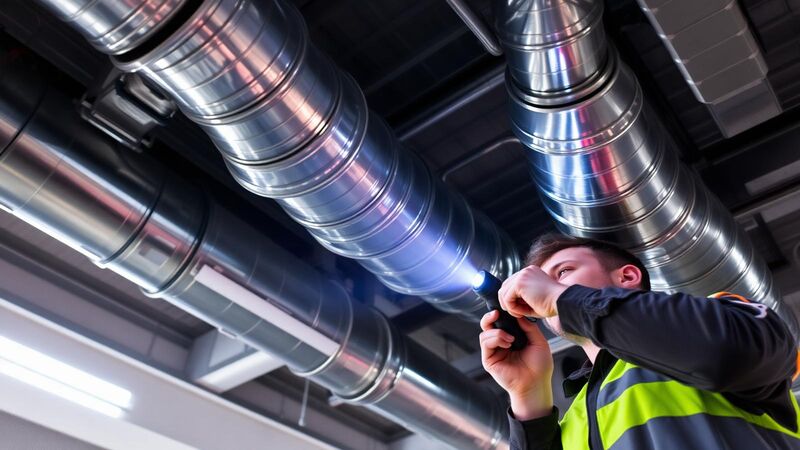
Deposit Thickness Testing (DTT) for Ventilation Ductwork
Independent ventilation hygiene assessors · Focused on impartial evidence
Deposit Thickness Testing (DTT) gives a quantitative, on-site measure of how much dry deposit has built up on the inside of your ductwork. It turns 'it looks dusty' into a documented reading, in microns, that can be compared against TR19 Air criteria and re-tested after any cleaning.
Established 1999 · 2,500+ assessments · SafeContractor approved · BOHS Affiliate Member · London & South East
What DTT is
DTT measures the thickness of dry deposit on a defined area of duct surface. The result is read on site, in microns, so condition can be recorded and compared between locations, between systems and before and after cleaning. It is one of the test methods described in BESA TR19® Air (Version 2, 2026).
When DTT is useful
Clients use DTT for a range of purposes.
- Planned ventilation hygiene surveys
- Pre-clean condition assessment and cleaning specification
- Post-clean verification against the pre-clean readings
- Targeted investigation of dust at grilles or occupant complaints
- Audit, insurer or landlord evidence
- Building handover, acquisition or a new FM contract
- Prioritising cleaning across a multi-site portfolio
Where DTT is — and is not — suitable
DTT is reliable only on the right surface and deposit. We check suitability at every location and switch method where needed.
| Suitable | Not suitable, or needs another method |
|---|---|
| Flat, rigid metal duct surfaces | Spiral ductwork, where the seam profile prevents a reliable reading |
| Dry, loose dust deposits | Wet or greasy deposits — WFTT is used instead |
| Accessible, representative test locations | Inaccessible areas, heavily corroded or damaged surfaces |
| General supply, extract and recirculation systems | Flexible, fibrous or lined ductwork and irregular surfaces |
Swipe sideways to see the full table →
DTT compared with other methods
Each method answers a slightly different question.
| Method | Result | Best for | Limitation |
|---|---|---|---|
| Visual inspection | Photographs and condition notes | Every survey | Not quantitative on its own |
| DTT | Deposit thickness in microns, on site | Condition surveys and pre/post-clean comparison on suitable surfaces | Not suitable on spiral, wet, greasy or irregular surfaces |
| Vacuum test (EVT) | Dust mass in g/m², gravimetric | Quantitative verification and surfaces where DTT is unsuitable | Needs weighing, so results are not instant |
| WFTT | Wet grease thickness in microns | Kitchen extract systems | For grease only |
Swipe sideways to see the full table →
What the numbers mean
TR19 Air compares results with cleanliness levels that depend on the system and the risk category of the building. Historically, supply and recirculation ductwork needed cleaning when DTT readings exceeded 60 µm, and extract ductwork above 180 µm. Current TR19 Air aligns its acceptance levels with the cleanliness quality classes in BS EN 15780, which are set by building risk.
| Measure | Level | Notes |
|---|---|---|
| DTT — supply and recirculation (historic TR19 level) | 60 µm | Now aligned with BS EN 15780 classes |
| DTT — extract (historic TR19 level) | 180 µm | Now aligned with BS EN 15780 classes |
| Vacuum test — supply and recirculation, medium-risk buildings (offices, hotels, restaurants, schools) | Below 3.0 g/m² | Current BS EN 15780-aligned level |
| Vacuum test — secondary ductwork, medium-risk buildings | 4.5 g/m² or less | Current BS EN 15780-aligned level |
Swipe sideways to see the full table →
How test locations are chosen
We take readings at a minimum of three locations per system, and more for larger or more complex systems. Readings are taken at representative locations, not at random. We plan them from the system layout and the purpose of the survey, so the results describe the system rather than a single convenient access panel.
- Proximity to intakes, filters, coils and fan sections
- Low-velocity zones, bends and changes of direction, where deposits settle
- Main runs, risers and branches in proportion to the system
- Areas linked to complaints or visible contamination
- Use history, previous cleaning and filter condition
How a DTT survey works
A DTT survey follows six steps.
Review
We review drawings, asset information and previous reports, and agree the purpose of the survey.
Scope and access
We agree the systems included, access points, permits and timing.
Plan test points
We set out representative test locations for each system.
Test and photograph
We take documented DTT readings and photographs at each location, switching method where DTT is not suitable.
Interpret
We summarise readings by system and compare them against TR19 Air criteria.
Report
We issue a report with conclusions, risk priority, recommended actions and re-test advice.
Independent of cleaning
Our results are not linked to any cleaning sale.
Areas we cover
We carry out DTT surveys across London, Kent, Surrey, Essex, Sussex, Hertfordshire, Berkshire and the wider South East.
What DTT cannot tell you
- It does not establish whether microbial contamination is present — microbiological sampling can be added where needed
- It does not prove or rule out an indoor air quality problem
- It does not confirm ventilation performance or air-change rates
- DTT provides efficient screening; WFTT or vacuum tests are used for specific grease types or surface requirements.
- It describes the tested locations; untested or inaccessible sections are recorded, not assumed
What your DTT report includes
- Scope, purpose and system boundaries
- Duct system register
- Test-point plan
- Individual DTT readings at each location
- Mean, minimum and maximum by system where appropriate
- Photographic record linked to test points
- Limitations and assumptions
- Conclusions and risk priority
- Recommended actions and re-test advice
Related ventilation hygiene and indoor air quality services
Frequently Asked Questions
Related ventilation hygiene and indoor air quality services
Need Indoor Air Quality Testing?
Get a no-obligation quote. We provide IAQ testing, ventilation assessment and environmental monitoring across London and the South East.