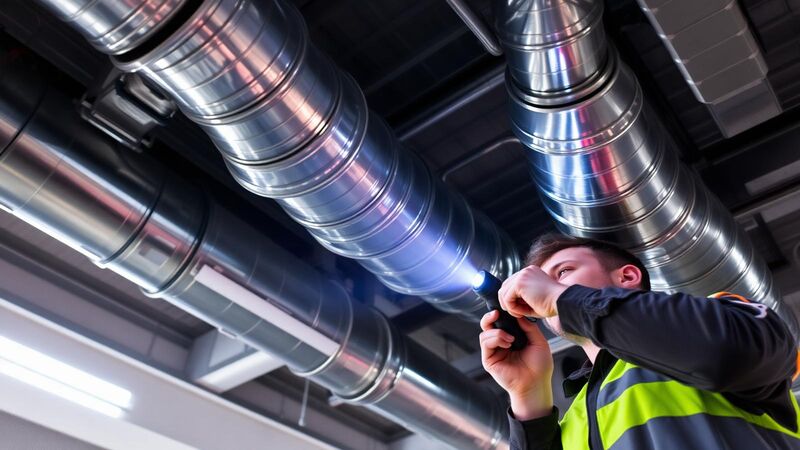
TR19 Air Ventilation Hygiene Assessments for Commercial Buildings
Independent ventilation hygiene assessors · Focused on impartial evidence
A TR19 Air assessment tells you what condition your ventilation systems are actually in, what action is justified and how to prove it afterwards. Green Air Monitoring is an independent assessor: we do not clean ductwork, so our findings and recommendations are never influenced by the sale of cleaning work.
Established 1999 · 2,500+ assessments · SafeContractor approved · BOHS Affiliate Member · London & South East
What TR19 Air is — and what it is not
TR19® Air is the Building Engineering Services Association (BESA) guidance on the internal cleanliness of ventilation systems. The current edition is Version 2, published in March 2026. It sets out how systems should be inspected, how cleanliness is measured and how results and cleaning works should be reported.
When a TR19 assessment is appropriate
Most clients commission an assessment for one of five reasons. Each needs a slightly different scope, so we agree the purpose before we survey.
| Assessment type | Typical trigger | What you get |
|---|---|---|
| Routine planned assessment | Annual or PPM-scheduled inspection | Condition evidence for each system and a decision on whether cleaning is needed |
| Reactive investigation | Dust at grilles, odours, occupant complaints, suspected contamination | Findings linked to the complaint, with next steps |
| Pre-clean specification | Cleaning is being considered or tendered | A defined, proportionate cleaning scope based on measured condition |
| Post-clean verification | Cleaning works have been completed by a contractor | Independent confirmation that the cleaning achieved the required standard |
| Acquisition, handover or due diligence | Building purchase, lease start or end, new FM contract | A baseline record of system condition at a fixed point in time |
Swipe sideways to see the full table →
What we inspect
We inspect the parts of the system that are accessible and relevant to the purpose of the assessment, and we record anything we cannot access.
- Outside-air intakes and louvres
- Air-handling units, including filter sections, cooling and heating coils and fan chambers
- Main supply and extract ductwork
- Risers and branch ductwork
- Dampers where visible and accessible
- Grilles, diffusers and terminal units
How we choose the test method
No single test suits every system. We select the method to suit the duct material, surface, deposit and purpose, and we explain the choice in the report.
| Method | What it measures | Typically used for |
|---|---|---|
| Visual inspection and photography | Condition, visible deposits, damage and debris | Every assessment — supports all other results |
| Deposit Thickness Test (DTT) | Thickness of dry deposit on the duct surface, in microns, measured on site | Suitable flat metal duct surfaces; condition surveys and pre/post-clean comparison |
| Vacuum test (EVT, formerly PVT) | Mass of dust per square metre from a template area (typically 100 × 100 mm), determined gravimetrically | Quantitative verification, including where DTT is not suitable |
| Wet Film Thickness Test (WFTT) | Thickness of wet or soft grease deposits, in microns | Kitchen extract systems (assessed under TR19 Grease) |
| Microbiological surface sampling | Bacteria and fungi on duct or AHU surfaces, by laboratory analysis | Odours, visible growth, damp or complaints — added where justified |
Swipe sideways to see the full table →
How a TR19 assessment works
A typical assessment follows six steps.
Review system information
We review drawings, asset lists, previous reports and cleaning records, and confirm the purpose of the assessment.
Agree scope and access
We agree which systems are included, access arrangements, permits and any out-of-hours working.
Plan test locations
We select representative test locations for each system — at least three per system, and more for larger or more complex systems — based on layout, air velocity, bends, filters, fan sections and visible condition.
Inspect and test
We inspect, photograph and test each location using the selected method, recording anything inaccessible.
Interpret the results
We classify each system against the TR19 Air criteria and relate the findings to the purpose of the assessment.
Report and recommend
We issue a report with prioritised, proportionate recommendations and advise when to re-inspect or verify.
What happens after the survey
Our recommendations follow the evidence. There are three typical outcomes.
No action needed
The system meets the criteria. We recommend the next inspection date and any monitoring to continue.
Targeted cleaning or access improvements
Specific systems or sections need cleaning, or access panels need adding. We define the scope so that you can tender it, and we can verify the work independently afterwards.
Further investigation
The findings suggest a wider issue, such as poor filtration, external pollution ingress, damp, construction dust or occupant complaints. We can connect the ductwork findings with indoor air quality or ventilation-failure investigation rather than recommending cleaning by default.
Independent post-clean verification to TR19 Air Version 2
Version 2 of TR19 Air (March 2026) formalises what should be reported after cleaning. When your contractor has finished, we check the work independently rather than relying on self-certification.
- We re-test at the same locations as the pre-clean survey, using the same method
- We review the contractor's Post-Work Verification Report, including before-and-after photographs, test results, site plan and access-point details
- We check that inaccessible areas are recorded, not assumed clean
- We confirm the outcome for each system: Full Clean, Partial Clean, Inspection (Outcome 'Clean') or Inspection (Outcome 'Not Clean')
Free buyer guides
Use our practical guides to check a TR19 report, understand your duties or compare assessors before approving work.
Who we work with
We assess ventilation systems in offices and commercial buildings for facilities management companies, managing agents, landlords, corporate occupiers, retail and hospitality operators and estates teams across London and the South East.
Limitations and what this assessment cannot tell you
A TR19 assessment is evidence of the condition found on the day of the survey, within the agreed scope.
- It covers accessible sections only; inaccessible areas are recorded, not assumed clean
- It does not by itself establish microbial contamination — microbiological sampling can be added where needed
- It does not measure ventilation performance or confirm that air-change rates are adequate
- It does not prove or rule out an indoor air quality problem on its own
- Results reflect the date of the survey; conditions change with use, filtration and maintenance
What your report includes
Every report is structured so it can go straight into your compliance records or audit file.
- Executive summary and scope, including system boundaries
- System register and access-point schedule
- Test locations marked on a plan or schematic
- Individual results with the method used at each location
- Photographs linked to each location
- Classification against TR19 Air criteria
- Limitations and inaccessible areas
- Prioritised action plan and re-inspection or verification advice
Do I need a ventilation hygiene survey? 60-second check
1.Has it been more than 12 months since your ventilation systems were last inspected — or do you not know?
2.Can you see dust or staining around grilles and diffusers?
3.Have staff or tenants complained about stuffiness, odours or dust?
4.Has there been construction, fit-out or refurbishment work in or near the building since the last inspection?
5.Have an insurer, landlord, auditor or client asked for TR19 evidence?
6.Has a contractor recommended cleaning without showing you measured results?
7.Has ductwork recently been cleaned without independent verification?
8.Does the building have a commercial kitchen?
Your result
- Kitchen extract: assess grease with WFTT under TR19 Grease.
- Independent post-clean verification is recommended.
- Get an independent pre-clean survey before approving the quote.
- A formal TR19 Air assessment will give you the evidence requested.
- A condition survey with quantitative testing is recommended; we may add indoor air quality testing if complaints are involved.
- A routine TR19 Air assessment is due.
- Your systems may not need a survey yet. Keep annual inspections in your PPM schedule, and check again if anything changes.
This check is a guide only and does not replace an assessment.
Related ventilation hygiene and indoor air quality services
Frequently Asked Questions
Related ventilation hygiene and indoor air quality services
Need Indoor Air Quality Testing?
Get a no-obligation quote. We provide IAQ testing, ventilation assessment and environmental monitoring across London and the South East.