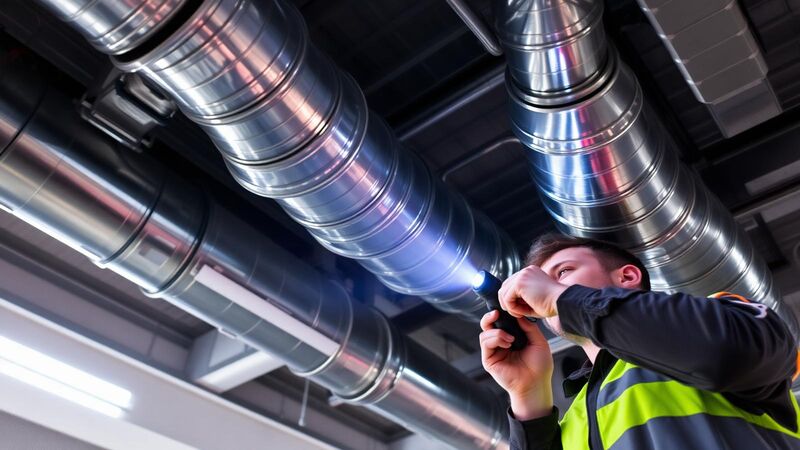
Kitchen Extract Grease Assessment and WFTT Surveys
Independent ventilation hygiene assessors · Focused on impartial evidence
Grease in kitchen extract systems is a distinct fire risk and needs a different assessment from general ventilation ductwork. We inspect the whole extract route, measure grease deposits with Wet Film Thickness Testing (WFTT) and give you independent evidence of condition and cleaning need.
Established 1999 · 2,500+ assessments · SafeContractor approved · BOHS Affiliate Member · London & South East
Who it is for
- Restaurants, cafés and hotel kitchens
- Staff restaurants and catering in offices
- Facilities and catering contract managers
- Landlords and managing agents of mixed-use buildings
Why kitchen extract is assessed separately
Cooking releases grease that condenses and builds up inside canopies, filters and ductwork. Unlike dry dust, it is combustible and can spread fire through the extract route. BESA publishes separate guidance for these systems, TR19® Grease, with its own measurement methods and cleaning frequencies.
What we inspect
We inspect the whole extract route.
- Canopies and grease filters
- Horizontal and vertical ductwork
- Risers
- Extract fans
- Discharge points
- Access panels, including whether there are enough of them to allow cleaning and inspection
How grease is measured
Wet Film Thickness Testing (WFTT) uses a comb gauge to measure the depth of wet or soft grease deposits, in microns. It is the method for greasy deposits, where Deposit Thickness Testing is not suitable. We take readings at representative locations along the extract route and photograph each one.
| Deposit | Method | Guidance |
|---|---|---|
| Wet or soft grease | WFTT | TR19 Grease |
| Hardened or dry deposits in kitchen ductwork | Assessed case by case; we explain the method used | TR19 Grease |
| Dry dust in general ventilation ductwork | DTT or vacuum test (EVT) | TR19 Air |
Swipe sideways to see the full table →
What the numbers mean
TR19 Grease sets grease-deposit limits measured by WFTT.
| Reading | What it means |
|---|---|
| Mean of 200 µm or more | Grease must be controlled so the mean does not exceed 200 µm between scheduled cleans — cleaning is due |
| 500 µm or more at any location | Immediate spot cleaning is required at that location |
| After cleaning | Deposits should be well below the 200 µm threshold, confirmed by post-clean WFTT at the same locations |
Swipe sideways to see the full table →
Typical assessment frequency
TR19 Grease links frequency to how heavily the kitchen is used. As a guide: heavy use (12–16 hours a day) every 3 months, moderate use (6–12 hours) every 6 months, light use (2–6 hours) every 12 months. We recommend a regime for your kitchen based on its use and risk assessment.
What insurers and inspectors usually ask to see
Requirements vary by insurer, policy and premises, but these records are the ones most commonly requested after an inspection, an audit or a fire.
- Dated post-clean reports for the whole extract route, not just the canopy
- WFTT readings before and after cleaning, at identified locations
- Before-and-after photographs linked to those locations
- A record of any sections that could not be accessed
- Evidence that cleaning frequency matches kitchen use
- Access-panel locations and any recommendations to add more
What affects the cost of an assessment
- Length and complexity of the extract route, from canopy to discharge
- Number of floors, risers and fans
- Access — ceiling voids, roof access, permits and out-of-hours working
- Whether access panels are already in place
- Number of kitchens or sites assessed together
- Whether post-clean verification is included
Free guide
Use our practical guide to understand TR19 Grease, WFTT limits and the records FM teams and landlords should keep.
How an assessment works
A kitchen extract assessment follows five steps.
Review
We review previous cleaning records, drawings and any insurer requirements.
Plan
We agree access, timing around service hours and the route to be inspected.
Inspect and measure
We inspect the route from canopy to discharge and take WFTT readings at representative locations.
Report
We report condition, readings, access issues and whether cleaning is needed, with a defined scope.
Verify
After cleaning by your contractor, we can re-test to confirm the result independently.
Limitations and what this assessment cannot tell you
- Readings describe accessible, tested locations; inaccessible sections are recorded
- Where access panels are missing, parts of the route cannot be assessed until access is improved
- It is an assessment of grease condition, not a full fire risk assessment of the premises
What your report includes
- Extract route plan from canopy to discharge
- Access-panel schedule, including gaps
- WFTT readings at each location
- Photographs linked to locations
- Condition against TR19 Grease criteria
- Cleaning scope, if needed
- Recommended assessment frequency
Do I need a ventilation hygiene survey? 60-second check
1.Has it been more than 12 months since your ventilation systems were last inspected — or do you not know?
2.Can you see dust or staining around grilles and diffusers?
3.Have staff or tenants complained about stuffiness, odours or dust?
4.Has there been construction, fit-out or refurbishment work in or near the building since the last inspection?
5.Have an insurer, landlord, auditor or client asked for TR19 evidence?
6.Has a contractor recommended cleaning without showing you measured results?
7.Has ductwork recently been cleaned without independent verification?
8.Does the building have a commercial kitchen?
Your result
- Kitchen extract: assess grease with WFTT under TR19 Grease.
- Independent post-clean verification is recommended.
- Get an independent pre-clean survey before approving the quote.
- A formal TR19 Air assessment will give you the evidence requested.
- A condition survey with quantitative testing is recommended; we may add indoor air quality testing if complaints are involved.
- A routine TR19 Air assessment is due.
- Your systems may not need a survey yet. Keep annual inspections in your PPM schedule, and check again if anything changes.
This check is a guide only and does not replace an assessment.
Related ventilation hygiene and indoor air quality services
Frequently Asked Questions
Related ventilation hygiene and indoor air quality services
Need Indoor Air Quality Testing?
Get a no-obligation quote. We provide IAQ testing, ventilation assessment and environmental monitoring across London and the South East.